CV vs Resume: The Difference, and Which One the UK Wants
In the UK a CV and a resume are the same thing and everyone says CV. In the US they are different documents. Here is the difference between a CV and a resume in each market, what CV stands for, and how to turn one into the other.
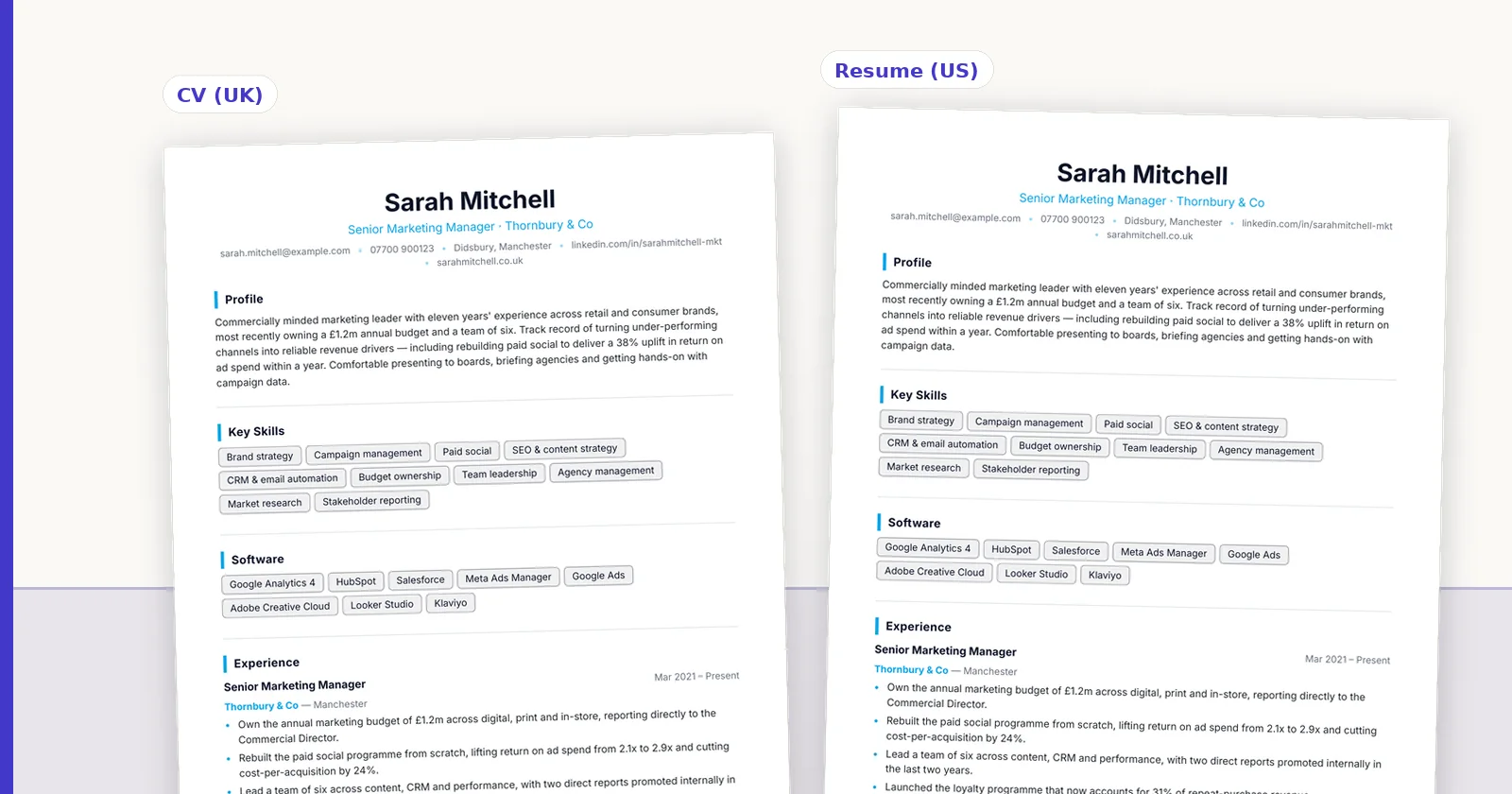
The difference between a CV and a resume depends on where you are. In the UK, Ireland and most of Europe, the document you send with a job application is called a CV, and 'resume' is rarely used. In the US and Canada the same document is a resume, and a CV means something else: a long academic record of research, publications and teaching. So the CV vs resume question has two answers, and which one applies depends on the employer reading it. This guide explains both, what CV stands for, how long each should be, and how to convert a UK CV into a US resume or back.
What CV stands for, and what resume means
CV stands for curriculum vitae, Latin for roughly 'the course of one's life'. Resume comes from the French résumé, meaning a summary. The names describe the original difference: a CV was the full record, a resume the short version.
In everyday UK use that distinction has disappeared. A UK CV is a two-page summary of your experience, written for a particular role, which is exactly what an American would call a resume.
CV vs resume in the UK
UK employers, recruiters and careers services say CV. A UK CV is usually two sides of A4, in reverse-chronological order, with a short personal statement at the top, your experience, education and skills, and no photo, date of birth or marital status.
If a UK advert asks for a resume, it almost always means a CV; the word is borrowed, not a request for a different document. Send your normal CV. Our UK CV formatting guide covers the conventions, and how long a CV should be covers the exceptions to two pages.
Resume vs CV in the US
In the US a resume is the standard job application document: one page for early career, two for experienced candidates, focused on results and tailored to the role. US employers generally do not expect a photo, date of birth or personal details.
A US CV is a different, longer document used mainly for academic, research, scientific and medical roles. It lists everything: degrees, publications, conference talks, grants, teaching and professional memberships, and it can run well past two pages. If an American employer outside academia asks for a CV, it is worth checking whether they mean a resume.
Difference between CV and resume, side by side
The difference between resume and CV conventions is clearest laid out by market: a UK CV and a US resume are close cousins, and the US academic CV is the odd one out.
| UK CV | US resume | US academic CV | |
|---|---|---|---|
| Used for | Almost every job application | Almost every job application | Academic, research, scientific and medical roles |
| Usual length | Two sides of A4 | One page early career, two when experienced | As long as the record requires |
| Opens with | A short personal statement | A summary or objective | Education and research interests |
| Photo and date of birth | Leave out | Leave out | Leave out |
| Tailored to each role | Yes | Yes | Partly; the record stays complete |
CV vs resume around the world
Outside the UK and the US, the word and the conventions both shift. The table gives the usual pattern in the markets people most often apply to from the UK. Treat it as a starting point: individual employers, sectors and adverts vary, and the advert and the country's own careers guidance always win.
Two differences catch people out more than the word itself. One is personal details: employers in parts of continental Europe and the Middle East may still expect some of the details a UK CV leaves out. In Germany, for example, the 2006 equal treatment law (the AGG) means a photo is no longer required, but many applicants still include one. The other is length: a US resume for an early-career applicant is often a single page, shorter than the UK two-page norm, while senior candidates in most markets use two.
| Market | Usual word | Typical length | Photo and personal details |
|---|---|---|---|
| UK and Ireland | CV | Two pages | Leave out photo, date of birth, marital status |
| US | Resume (CV means academic) | One to two pages | Leave out |
| Canada | Resume (CV mainly academic) | One to two pages | Leave out |
| Australia and New Zealand | Resume or CV, used interchangeably | One to two pages (SEEK's guidance) | Usually leave out |
| Germany | Lebenslauf (CV) | Usually one to two pages, tabular | Photo optional, still common |
| Rest of the EU | CV; the EU's Europass format is widely recognised | One to two pages | Varies by country; check local guidance |
| Gulf states | CV | Varies; follow the advert | Photo and nationality more often included than in the UK; follow the advert |
The details that change between a UK CV and a US resume
Even where the two documents do the same job, the small conventions differ, and a recruiter notices them. If you are applying across the Atlantic, these are the details to change rather than the content.
Education is the most visible one. A UK CV lists degree classifications (2:1, First) and, for early-career candidates, A-levels or GCSEs; a US resume lists a GPA if it is strong and never mentions A-levels. References are another: many UK CVs end with 'References available on request', which US resumes simply leave out. Neither market wants the referees' names on the document.
- Spelling: organisation and colour in the UK, organization and color in the US
- Dates: 03/2021 means March in both, but write months as words to avoid 4/3 ambiguity
- Paper: A4 in the UK, US Letter in the US; export the PDF at the right size
- Education: degree class and A-levels in the UK, GPA (if strong) in the US
- Right to work: UK applicants often state it briefly; US resumes rarely include it
- Length: two A4 pages in the UK; one US Letter page for most early-career US resumes
Can I use my CV as a resume?
Within the UK, yes: they are the same document. For a US application, a UK CV usually needs a few changes rather than a rewrite.
Going the other way, a US resume becomes a UK CV with the reverse changes: switch to UK spelling, check the length fits two A4 pages, and add a personal statement if the resume opens with an objective.
- Switch to US spelling and US date formats (month before day)
- Trim to one page if you are early career, two if experienced
- Rename the personal statement as a summary and make it results-led
- Change paper size from A4 to US Letter before exporting the PDF
- Remove anything a US employer would not expect, such as a full address line or nationality
Converting a UK CV to a US resume: a worked example
Here is what the changes in the checklist above look like on one CV, and what the difference between a CV and a resume means in practice. Our fictional candidate, Priya, is a UK management accountant applying for a financial analyst role in Boston.
Her UK CV opens with 'Personal statement: Chartered management accountant (CIMA) with eight years in FMCG, running month-end close for a three-site business.' On the US resume that becomes a 'Summary' with the result first: 'CIMA-qualified financial analyst who cut month-end close from nine days to five across three manufacturing sites.' The facts are identical; the order leads with the outcome, which is the US convention.
Her education section loses the A-levels and keeps the degree, with the classification explained ('BSc Accounting and Finance, First Class Honours') because US readers may not know what a First means. 'Organisation' becomes 'organization', the dates become 'March 2021 to Present', the paper size changes from A4 to US Letter, and the full home address shrinks to 'Leeds, UK (relocating to Boston)'. The two pages stay two pages, because with eight years of experience a two-page US resume is normal.
What she does not change is the substance. A US resume is not an invitation to inflate titles or invent figures, and a recruiter who checks a reference will find the difference. If you use software or AI to help with the conversion, check every figure, title and date against your original.
CV or resume by sector
The sector you apply to can matter as much as the country. In most private-sector jobs on both sides of the Atlantic, the document is the same two-page summary whatever it is called. A few sectors work differently, and it is worth knowing before you send anything.
In healthcare, US doctors and scientists generally use a CV in the academic sense, listing training, licences, publications and research, while many UK NHS roles are applied for through an application form on NHS Jobs rather than with a CV at all. In teaching, UK schools often use their own application forms too. In tech, the document is short in both markets and links to work you can show, such as a portfolio or code repository. In creative roles, the CV is short and the portfolio carries the evidence. In academia, both markets expect the long academic CV described below.
- Most private-sector jobs: a two-page CV (UK) or a one to two page resume (US)
- Academia and research: a full academic CV in both markets
- US medicine and science: an academic-style CV
- Many NHS and school roles: an application form, sometimes with a supporting statement
- Tech and creative: a short CV or resume plus links to your work
What goes in an academic CV
An academic CV is the one place where the old meaning of curriculum vitae survives on both sides of the Atlantic. In the US it is the document that sets a CV apart from a resume. In UK universities it is still called a CV, but it is longer and organised differently from a UK job-hunting CV, because it is a record of a research career rather than a pitch for one job.
Length follows the record. An early-career researcher's academic CV may be two or three pages; a professor's can run much longer. What keeps it readable is a consistent order and a clear heading for each kind of output, so a selection panel can find publications or grants in seconds.
UK research funding has also moved towards a narrative format. UK Research and Innovation (UKRI) uses the Résumé for Research and Innovation (R4RI), based on the Royal Society's Résumé for Researchers, in funding applications that ask for a track record. It asks for written evidence of contributions to knowledge, to other people's development and to the wider research community, rather than a list. If a call asks for one, it replaces the traditional academic CV for that application; the word limit is set in the funding opportunity.
- Education, with thesis title and supervisor for a PhD
- Research interests, in a few lines
- Publications, grouped by type and in a consistent citation style
- Grants and funding, with your role and the funder
- Teaching and supervision
- Conference talks and invited presentations
- Professional service: reviewing, committees, editorial roles
- Memberships, and referees with contact details if the advert asks for them
Why some people say CV instead of resume
It is usage, not a difference in quality. British English settled on CV; American English settled on resume and kept CV for the academic document. Europe, the Middle East, Africa and much of Asia lean towards CV, and the EU's free Europass builder produces a standard CV format used across European countries. Australia and New Zealand use both words, often interchangeably.
The practical rule: use the word the advert uses, and follow the conventions of the country where the job is.
One document, both markets
ConnectIQ is built for both conventions: the UK side of the site says CV and the US side says resume, because the words mean different things to the people reading them. Upload your existing document, check what was read from it, and set it in any of our UK CV templates or US resume templates, then export PDF and Word. Your first conversion is free with no card.
FAQ
Q01What's the difference between a resume and a CV?
In the UK, nothing: CV is the normal word for the job application document and resume is rarely used. In the US, a resume is the standard one or two page application document, while a CV is a longer academic record of research, publications and teaching used for academic, research and medical roles.
Q02What does CV stand for?
Curriculum vitae, Latin for roughly 'the course of one's life'. Resume comes from the French résumé, meaning summary.
Q03Does the UK say resume or CV?
CV. UK employers, recruiters and careers services almost always say CV. If a UK advert asks for a resume, send your normal CV.
Q04Resume vs CV (UK): is there any difference?
No. In the UK the two words mean the same document, and CV is the one almost everyone uses. Asking for a CV or resume in UK job adverts means the same two-page application document.
Q05What is the difference between CV and resume in the US?
A US resume is the one or two page document for most jobs; a US CV is the long academic record for academic, research, scientific and medical roles, listing publications, grants, talks and teaching.
Q06Can I use my CV as a resume?
In the UK they are the same document. For a US application, adjust your CV: US spelling and date formats, US Letter paper, one page if you are early career, and a results-led summary in place of a personal statement.
Q07Is a CV longer than a resume?
In the US, yes: an academic CV can run to many pages, while a resume is one or two. In the UK a CV is usually two sides of A4, about the same length as an experienced American's resume.
Q08Why do some people say CV instead of resume?
Because of where they learned the word. British English uses CV for the job application document; American English uses resume and keeps CV for the academic version. Use the word the employer uses.
Q09What is the Latin meaning of curriculum vitae?
Roughly 'the course of one's life'. 'Curriculum' means a course or a running, and 'vitae' means of life. The plural is curricula vitae.
Q10Should I put a photo on my CV?
Not in the UK, Ireland, the US or Canada, where photos are not expected and can invite bias. In parts of continental Europe and the Middle East a photo is more common; in Germany it is optional but still often included. Follow the advert and the local convention.
Q11What is an academic CV?
A full record of a research career: education, research interests, publications, grants, teaching, supervision, talks and professional service. It is used for academic and research jobs in both the UK and the US, and it can run well past two pages.
Q12What is a narrative CV?
A CV written as short evidence-based narratives rather than lists. UKRI's version, the Résumé for Research and Innovation (R4RI), is used in research funding applications that ask for a track record, and the word limit is set by each funding call.
Q13Is a CV the same as a resume in Australia?
Broadly, yes. Australians use both words, often interchangeably, for the job application document. SEEK's career advice suggests one or two pages depending on experience. Check the advert for any length or format instructions.
ConnectIQ Editorial documents practical recruitment operations and the controls implemented in the ConnectIQ product. This guide is general operational information, not legal advice.