CV Personal Statement Examples: How to Write a CV Summary That Gets Read
Over thirty personal statement CV examples, from school leaver to director and across fourteen jobs, plus a simple formula for writing your own CV summary, how long it should be, and the phrases recruiters skip.
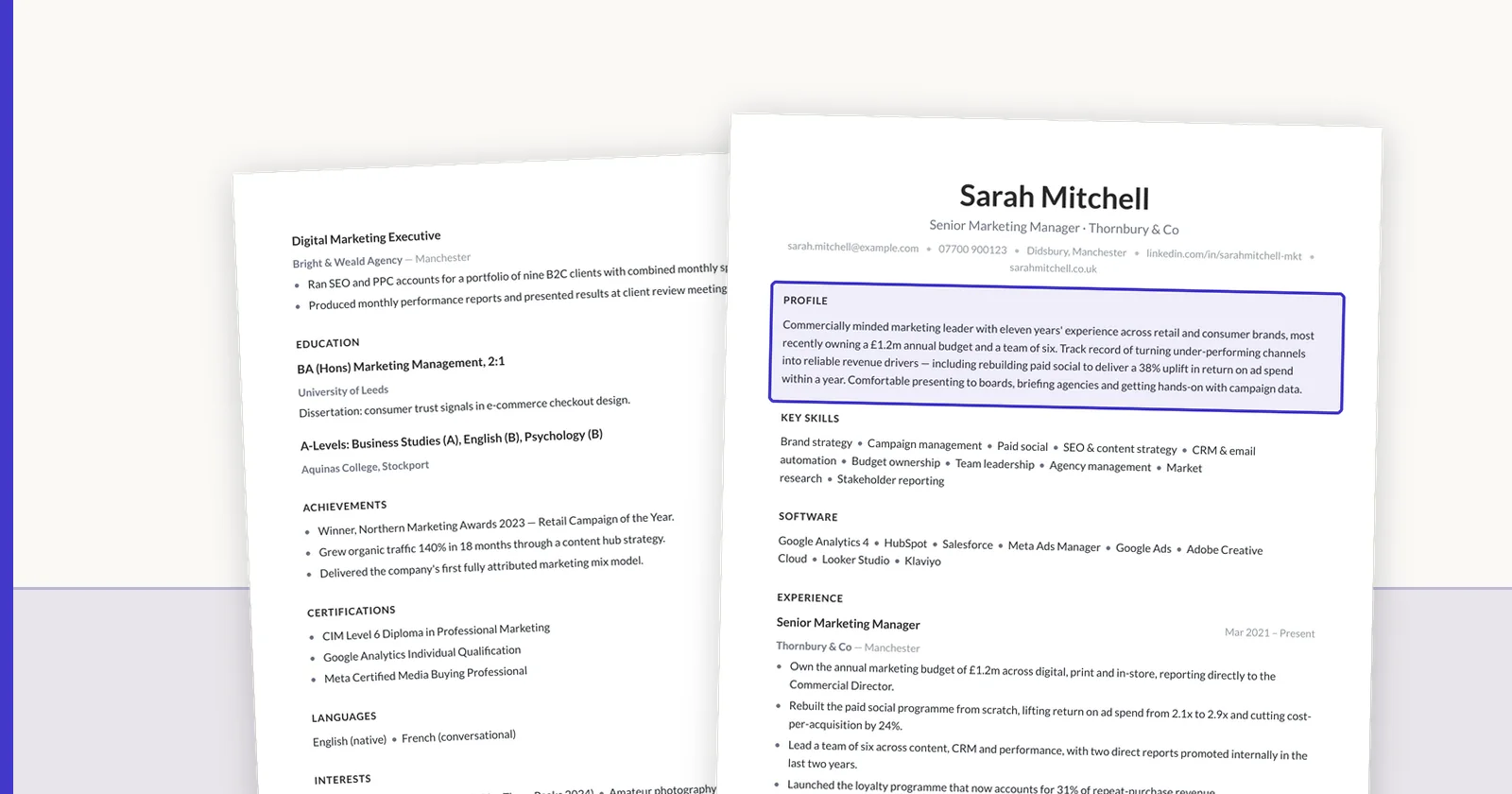
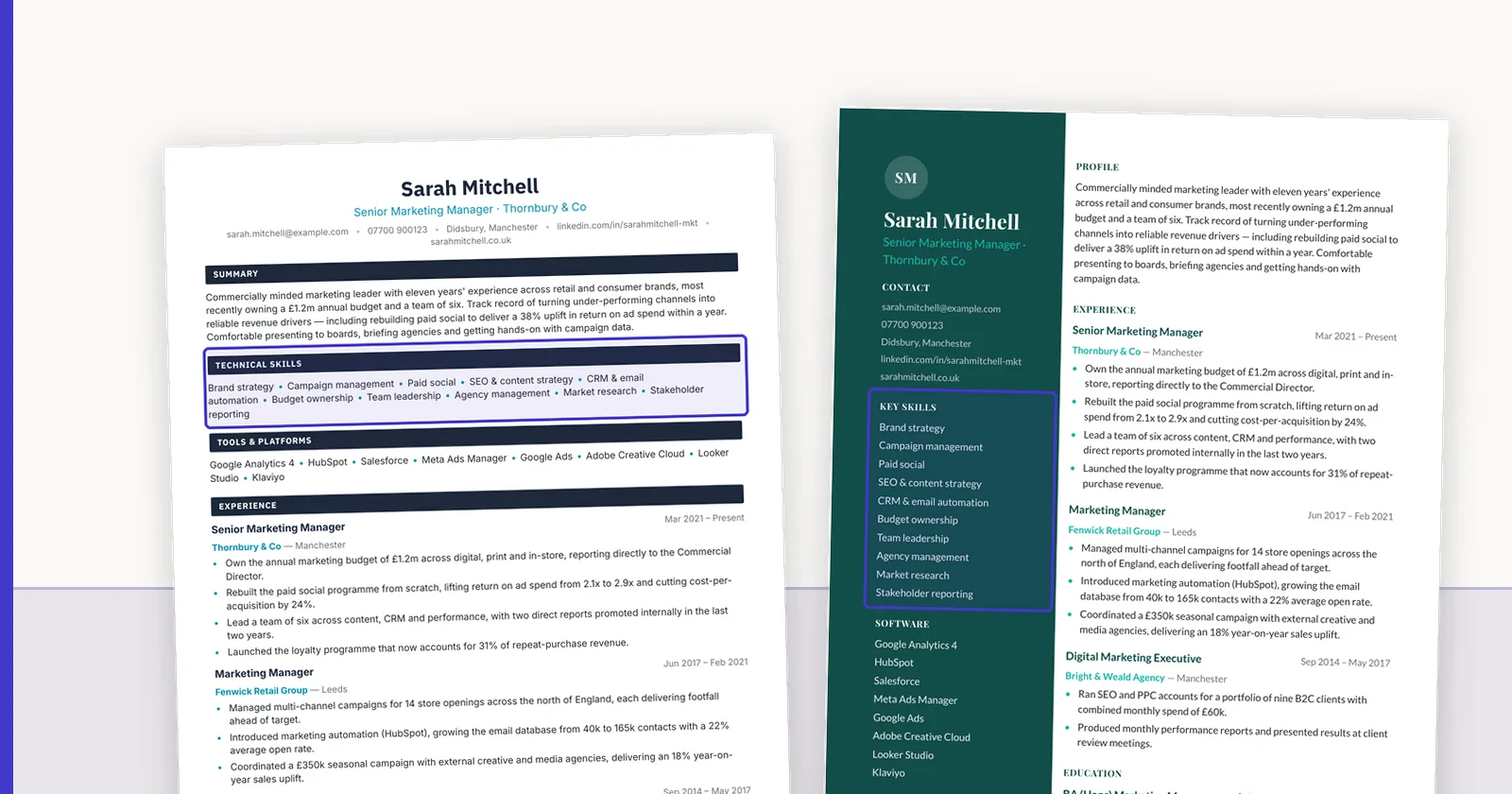
A personal statement on a CV, also called a CV summary or personal profile, is three or four lines at the top of the page that say who you are professionally, what you have done that proves it, and what you want next. It is the most-read paragraph on your CV and usually the weakest, because most people fill it with adjectives anyone could claim. Below are more than thirty personal statement CV examples, by career stage, by job and for tricky situations such as redundancy or a career break, with before-and-after rewrites, a formula you can reuse, and the specific things to cut. The examples are written for fictional people; swap in your own facts, never invented ones.
What a CV personal statement is for
The reader of your CV decides in the first few seconds whether to read on, and the top third of page one is where they decide. The personal statement is the part of that top third you fully control. Its job is not to describe your personality; it is to tell a stranger, quickly, what kind of professional you are and why you fit this role.
That is why a good CV summary is specific. 'Hard-working team player with excellent communication skills' could describe anyone, so it tells the reader nothing. 'Management accountant with seven years in manufacturing, running month-end close for a four-site business' could only describe you.
How to write a CV summary: a three-part formula
Most good CV summaries follow the same shape, whatever the career stage. Use it as a personal profile CV template and then make the wording your own.
Write it last, after the rest of your CV, so you can pull the strongest facts up from your experience rather than inventing claims that the page below does not support.
- Who you are: your current or target job title, your field and your level of experience, in one clause
- What proves it: one or two specific achievements, qualifications or responsibilities, with real numbers where you have them
- What you want: the kind of role you are looking for, matched to the job you are applying for
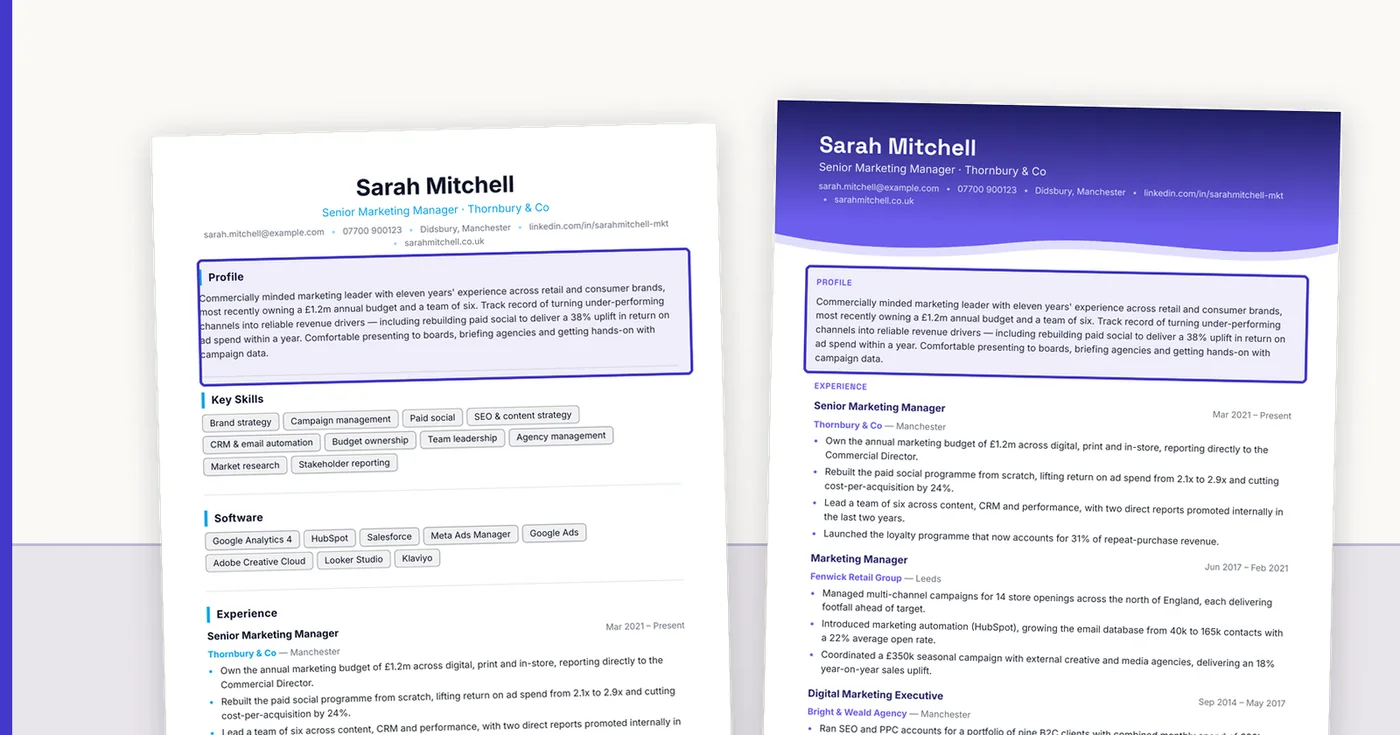
Personal summary for CV examples by career stage
Nine CV summary examples, which double as CV profile examples and professional CV summary examples for each stage, each three or four lines. Each one follows the formula above, and each is for a fictional candidate: use the structure, not the facts.
- School leaver: Reliable and organised school leaver with GCSEs in English, maths and science, and two years of Saturday work at a busy garden centre handling tills, stock and customer questions. Looking for an apprenticeship in business administration where I can build on my Excel and customer service skills.
- Graduate: Economics graduate (2:1, University of Sheffield) with a dissertation on regional housing data and a summer internship building weekly sales dashboards in Power BI. Looking for a graduate analyst role where clear reporting and careful data work are valued.
- Career changer: Primary school teacher of eight years moving into learning and development, with experience designing lessons for mixed abilities, training new staff and presenting to parents and governors. Recently completed a CIPD Level 3 certificate and looking for an L&D coordinator role.
- Returning after a career break: Experienced payroll administrator returning after a three-year career break, previously running monthly payroll for 400 staff on Sage and handling HMRC queries. Refreshed my skills with an updated payroll qualification this year and ready to start immediately.
- Customer service: Customer service adviser with four years in a contact centre handling billing and complaint calls, consistently resolving issues on first contact and coaching new starters. Calm under pressure and looking for a team leader role.
- Trades: Qualified electrician (18th Edition, ECS gold card) with six years on domestic and light commercial installs, from first fix to testing and certification. Safe, tidy and used to working directly with clients and site managers.
- Mid-career specialist: Management accountant with seven years in manufacturing, running month-end close and building the budget models a four-site business uses to plan production. Strong Excel and Sage skills and comfortable explaining numbers to non-finance managers.
- Manager: Operations manager leading a team of 30 in a regional distribution centre, responsible for shift planning, health and safety and a multi-million pound annual budget. Introduced a new rota system that reduced agency staffing costs. Looking for a senior operations role.
- Senior or executive: Commercial director with fifteen years in consumer goods, most recently leading UK sales and marketing for a mid-sized food brand through two retailer range reviews and a new product launch. Board experience and a track record of building teams that keep their best people.
Example of CV summary by job: fourteen more profiles
Fourteen more personal profile examples, this time organised by the kind of job rather than career stage. Every one is for a fictional person and follows the same three-part formula: who you are, what proves it, what you want. Find the closest match, keep the shape, and replace every fact with your own.
- Nurse: Registered adult nurse (NMC registered) with five years on a busy acute medical ward, including two as a band 6 deputy sister supporting students and newly qualified staff. Confident with deteriorating patients and discharge planning, and looking for a senior staff nurse post in respiratory care.
- Teaching assistant: Teaching assistant with three years in a Year 2 classroom, running phonics groups and supporting two pupils with EHC plans. Calm, consistent and trained in Team Teach, and looking for a permanent TA role in a primary school.
- Software developer: Back-end developer with four years building Python and PostgreSQL services for an online retailer, including the order pipeline that handles peak trading. Comfortable owning a service from design to on-call, and looking to move into a platform or infrastructure team.
- Data analyst: Data analyst with two years turning operational data into weekly Power BI reports for a housing association, and a background in customer service that makes me good at asking what a report is actually for. Looking for an analyst role with more SQL and modelling work.
- Marketing executive: Marketing executive with three years running email, paid social and content for a B2B software company, owning the monthly newsletter and the events calendar. Looking for a role with more ownership of campaign planning and budget.
- Sales: Field sales executive with six years selling building products to merchants across the North West, opening new accounts and managing a territory of established customers. Looking for an account management role with a larger customer base.
- HR adviser: CIPD Level 5 qualified HR adviser with four years in a multi-site retail business, handling employee relations cases from first meeting to outcome and supporting managers through absence and capability processes. Looking for an HR business partner role.
- Administrator or receptionist: Medical receptionist with three years at a busy GP surgery, managing appointment lines, repeat prescription requests and patient queries with care and discretion. Looking for a practice administrator role with more responsibility for systems and rotas.
- Hospitality: Restaurant supervisor with four years in an independent 80-cover restaurant, running the floor on busy services, cashing up and training new front-of-house staff. Level 2 food hygiene and personal licence holder, looking for an assistant manager role.
- Chef: Sous chef with seven years in hotel and restaurant kitchens, responsible for ordering, allergen records and the kitchen rota for a team of six. Looking for a head chef role in a fresh-food kitchen.
- Warehouse operative: Warehouse operative with three years in a high-volume distribution centre, holding counterbalance and reach truck licences and consistently trusted with goods-in checks. Looking for a team leader role.
- Care worker: Support worker with four years helping adults with learning disabilities live independently, including medication administration and person-centred support plans. Holds a Level 3 Diploma in Health and Social Care and looking for a senior support worker role.
- Project manager: PRINCE2-qualified project manager with eight years delivering office fit-outs and relocations for professional services firms, managing contractors, budgets and the people who have to move. Looking for a programme role in a property or facilities team.
- Student (CV summary example for students with a part-time job): Second-year business student working 15 hours a week at a high-street bank branch, helping customers with accounts and online banking. Looking for a summer internship in banking operations where I can use my customer experience and studies.
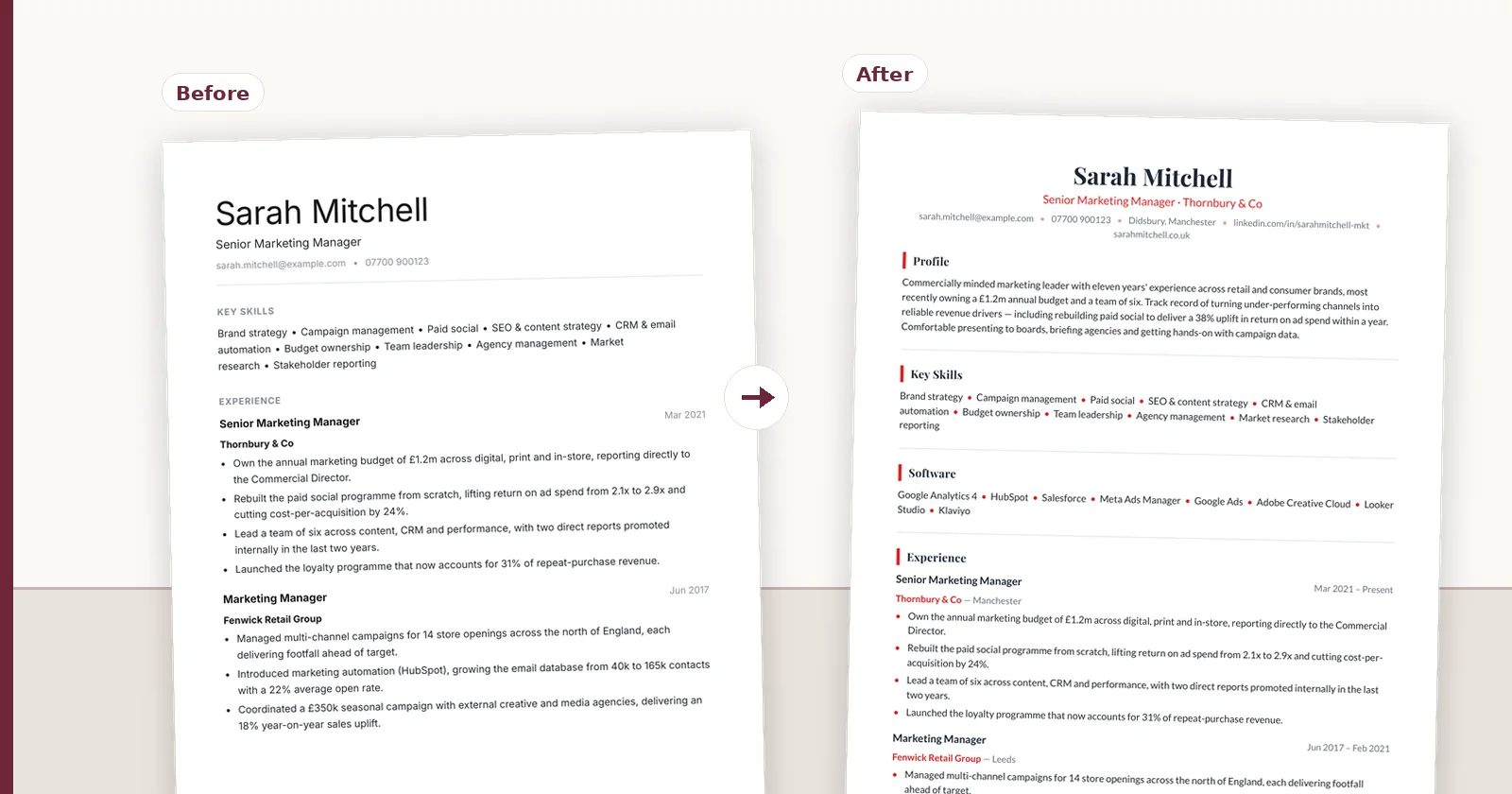
Personal statement CV examples, before and after
The quickest way to see what makes a statement work is to watch a weak one get fixed. Each pair below is for a fictional person; the weak version is typical of the profiles that pass across a recruiter's desk every day.
Before: 'I am a highly motivated, hard-working and passionate individual with excellent communication skills who works well in a team and on my own. I am looking for a challenging role where I can develop my skills.' After: 'Customer service adviser with four years in a utility contact centre, handling billing disputes and coaching new starters through their first month. Looking for a team leader role.' The adjectives went, the job title came first, and every remaining phrase is something only this person can say.
Before: 'Experienced professional with a proven track record of delivering results across a range of industries.' After: 'Procurement manager with ten years buying packaging and raw materials for food manufacturers, most recently running a supplier review that consolidated the supplier base.' 'Proven track record' and 'range of industries' are claims; the rewrite gives the reader a field, a scale and a thing that happened.
Before: 'Recent graduate seeking an opportunity to utilise my degree in a dynamic company.' After: 'Geography graduate (2:1, University of Leeds) with a GIS-based dissertation on flood risk and a summer placement mapping drainage assets for a water company. Looking for a graduate GIS or planning role.' The rewrite names the degree, the tool and the placement, which is what a graduate employer is screening for.
How long should a CV personal statement be?
Three to five lines, or roughly 50 to 120 words. Long enough for the three parts of the formula, short enough to be read whole in a few seconds. A profile that runs to a paragraph of eight lines is usually repeating what the experience section already says.
Recruiters who reformat CVs for clients routinely cut personal statements to two or three lines, keeping the specifics and dropping the adjectives, as our piece on what recruiters change on every CV describes. For the overall page count, see how long a CV should be.
First person, third person, or neither?
In the UK the usual convention is an implied first person with the 'I' left out: 'Management accountant with seven years in manufacturing' rather than 'I am a management accountant' or 'Sarah is a management accountant'. It reads as confident and saves words.
Full first person is acceptable if you keep the 'I's to a minimum. Third person ('Sarah is...') reads oddly on a CV you wrote yourself, and it is the form most likely to give away your name if a recruiter anonymises your CV for a client.
What to write in a personal statement CV readers trust
What to put in a CV summary comes down to a few rules that separate a profile that gets read from one that gets skipped.
- Lead with your job title or target role, not an adjective
- Use one real number or named qualification if you have one
- Match the role you are applying for: change the last line for each application
- Cut clichés: hard-working, passionate, results-driven, team player, go-getter
- Do not repeat your contact details, age or personal circumstances
- Never claim anything the rest of the CV cannot support
Phrases to cut, and what to write instead
Most weak personal statements are weak in the same way: they use words that sound good and mean nothing. Replace each with a fact.
| Instead of | Write something like |
|---|---|
| Hard-working and motivated | What you worked on and the result: 'cleared a two-month invoice backlog' |
| Excellent communication skills | Who you communicate with and how: 'present monthly figures to the board' |
| Team player | The team and your part in it: 'one of four planners covering 30 stores' |
| Proven track record | The track record itself, in one specific line |
| Passionate about | What you have done about it: a course, a project, a role |
| Seeking a challenging role | The role you want, in the employer's words |
| Results-driven | One result, with a number you can stand behind |
Personal statements for tricky situations
Some situations make the last line of a statement harder to write. The answer in each case is to be brief, honest and forward-looking, and to let the rest of the CV carry the detail. A personal statement is not the place to explain a gap at length; a short, factual line is enough, and an interview is where you can say more if you choose to.
Each example below is for a fictional person.
- After redundancy: Logistics planner with nine years in retail distribution, most recently planning store deliveries for a regional network until the depot closed this year. Looking for a planning role where I can start straight away.
- After a gap for caring or health: Bookkeeper with six years in practice, returning after a two-year break caring for a family member, with my software skills refreshed this year. Looking for a part-time bookkeeping role.
- Relocating: Primary teacher with five years' experience in Key Stage 2, moving to Bristol in the summer and looking for a permanent post from September.
- Stepping down in seniority: Former store manager looking for a supervisor role with more predictable hours, bringing ten years of retail operations, rota planning and staff training.
- From self-employment to employed: Self-employed decorator for eight years, running my own jobs from quote to finish for domestic and small commercial clients. Looking for a maintenance or facilities role with an employer.
How to write a personal summary in a CV for each job
The first two parts of the formula, who you are and what proves it, rarely change between applications. The third part should change every time. Read the advert, find the two or three things it cares about most, and make sure your statement points at them in the advert's own words.
Take our fictional management accountant from the examples above. For a manufacturing role, her last line might stay 'comfortable explaining numbers to non-finance managers'. For a role that stresses systems change, she would swap it for her part in moving month-end onto a new ledger. Same person, same facts, a different emphasis for a different reader.
Keep a master version of your CV with every achievement in it, and for each application copy it, edit the statement and reorder the skills. It takes ten minutes and it is the single change most likely to move a CV from the 'maybe' pile to the 'call' pile. Our guide to skills for a CV uses the same method for the skills section.
Can AI write your CV profile?
It can tidy one, and it will make it sound more polished. The risk is that a model asked to make a profile stronger reaches for a number or a scope word you never earned: 'supported a migration' becomes 'led a migration', or a vague improvement becomes a precise percentage. At interview, that is the line you will be asked about.
If you use AI, give it your own facts, ask it only to tighten the wording, and compare the result with your original line by line. Our guide to using AI on your CV without getting caught lists what to check.
ConnectIQ's rewrite modes run from no AI at all to a full rewrite, and every change to your profile is shown as a before-and-after you approve; employers, titles, dates and qualifications are restored word for word. Your first conversion is free with no card, and you can see the result in any of our CV templates. The tool checks facts; whether the new wording still means what you meant is yours to judge.
FAQ
Q01Should a CV include a personal statement?
In the UK, yes for most roles. A three to five line personal statement at the top of the CV tells the reader what kind of professional you are before they reach your experience. The main exceptions are academic CVs and very senior CVs that open with a short summary of board roles instead.
Q02What should I include in my personal statement for my CV?
Your current or target job title and level of experience, one or two specific achievements or qualifications that prove it, and the kind of role you want next. Leave out adjectives you cannot evidence, personal details and anything the rest of the CV does not support.
Q03What is the difference between a personal statement, a CV summary and a CV profile?
In UK CVs they are the same thing: the short paragraph at the top. 'Personal statement' and 'personal profile' are the more common UK terms; 'professional summary' and 'CV summary' are used more often in the US and in tech. A university personal statement is a different, much longer document.
Q04What is a CV summary?
A CV summary is the three to five line paragraph at the top of your CV that says who you are professionally, what proves it and what you want next. In the UK it is more often called a personal statement or personal profile.
Q05Can you give an example of a candidate summary?
Management accountant with seven years in manufacturing, running month-end close and building the budget models a four-site business uses to plan production. Strong Excel and Sage skills and comfortable explaining numbers to non-finance managers. (A fictional example; use your own facts.)
Q06What is a good opening line for a CV?
Your job title or target role followed by your field and experience, for example 'Customer service adviser with four years in a contact centre'. It answers the reader's first question immediately. Avoid opening with an adjective such as 'motivated' or 'passionate'.
Q07How do you write a professional CV summary with no experience?
Lead with what you are studying or have just completed, then the most relevant practical evidence you have: part-time work, volunteering, projects or a placement. Finish with the role you want. The school leaver and graduate examples above show the shape.
Q08Can ChatGPT write my personal statement?
It can draft or tighten one, but it will happily add achievements and figures you never gave it. Give it only your real facts, ask it to edit rather than invent, and check every claim against your experience before you send the CV.
Q09Should a personal statement be in the first or third person?
Use an implied first person with the 'I' left out, for example 'Management accountant with seven years in manufacturing'. Full first person is fine if you keep the 'I's to a minimum. Avoid third person on a CV you wrote yourself; it reads oddly and can reveal your name if the CV is anonymised.
Q10How do I tailor my personal statement for each job?
Keep the first two parts (who you are, what proves it) and rewrite the last line for each advert, pointing at the two or three things the employer cares about most, in their wording. Then reorder your skills to match.
Q11What skills should I list on my CV?
The ones the advert asks for that your experience proves: specific tools, qualifications and licences, plus two or three behavioural skills shown in your achievements. Our guide to skills for a CV has example lists by role.
Q12What are red flags on a CV?
Common ones include a personal statement that does not match the job, unexplained gaps or overlapping dates, claims the rest of the CV does not support, skill ratings and lists with no evidence, and spelling mistakes. A short, specific, honest statement at the top avoids the first and third.
ConnectIQ Editorial documents practical recruitment operations and the controls implemented in the ConnectIQ product. This guide is general operational information, not legal advice.