Skills for a CV: What to Put On It, Where, and How to Prove Each One
The skills to put on a CV are the ones the job asks for and your experience can prove. Here is how to choose them, where a CV skills section belongs, example lists by role, and the mistakes recruiters delete on sight.
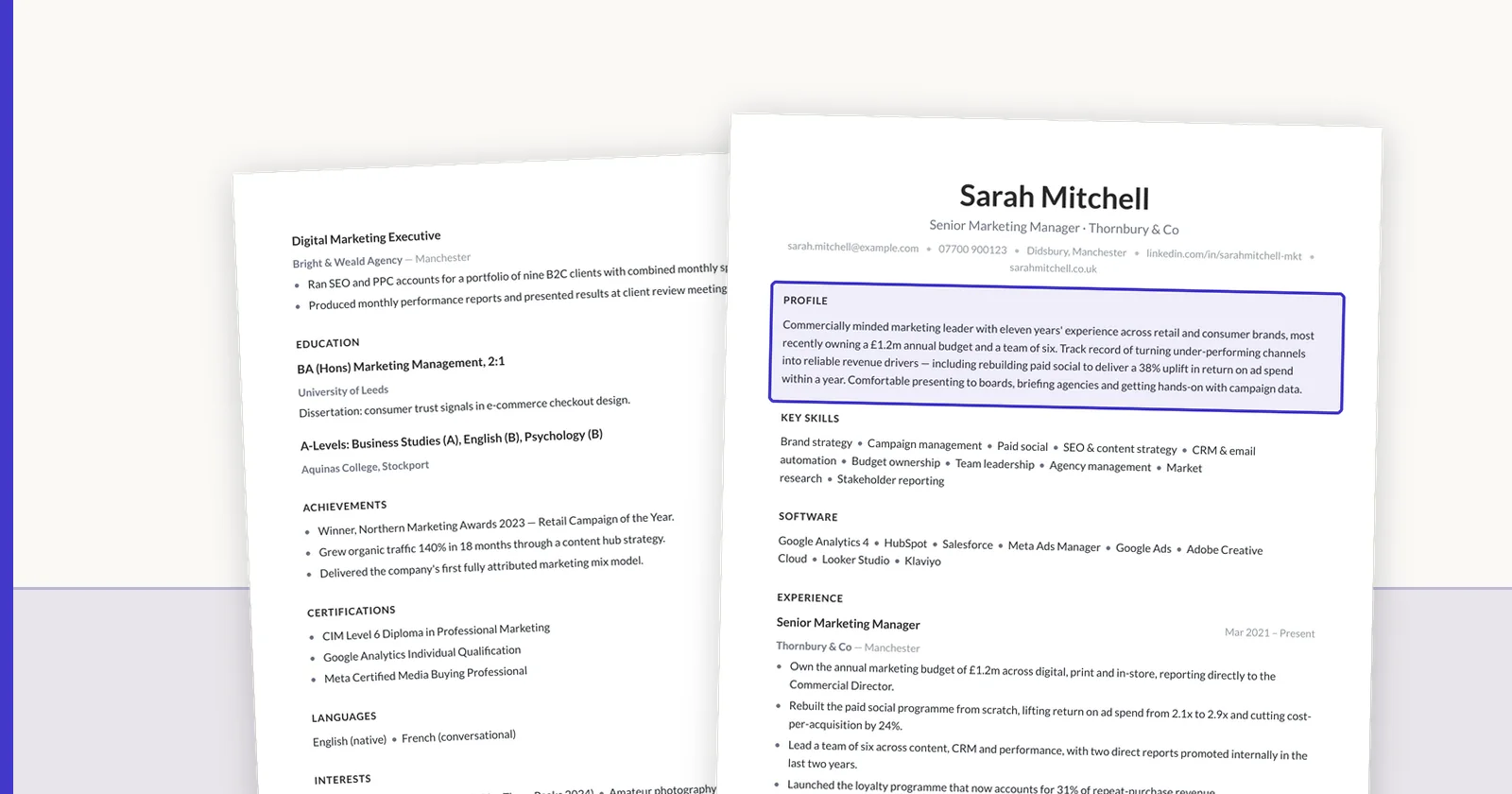
The best skills for a CV are the five to ten the job advert asks for that your experience can actually prove. List them once in a short CV skills section, then show each one working inside your role bullets, because a skill named without evidence reads as a claim and a skill shown in a result reads as a fact. Recruiters skim a skills list in seconds and then look for the proof underneath it. This guide covers how to choose the key skills to put on a CV, where to put them, how many to list, example lists by type of role, and the skills sections that quietly cost people interviews.
How to choose skills to put on CV applications
Start with the job advert, not with a list of skills you think sound impressive. Copy out every skill, tool and quality it mentions, then mark the ones you can back up with something you did. Those marked items are your key skills for this CV. Everything else is either a gap to address honestly or noise to leave out.
Use the advert's own wording where it is accurate. If the role asks for stakeholder management and your CV says relationship building, a recruiter searching their database for the advert's phrase may never find you. Mirroring the language is not gaming anything; it is making sure the person and the software reading your CV recognise the match. Our guide to what an ATS actually reads from your CV explains why exact terms matter more than synonyms.
Then cut. A list of skills for a CV that runs to thirty items tells the reader you could not decide which mattered. Five to ten well-chosen skills, each one evidenced further down the page, will do more than a wall of keywords.
- Take the skills straight from the advert, in its own words
- Keep only the ones your experience proves
- Add the tools and qualifications the role needs to function
- Drop anything every applicant would claim, unless the advert asks for it
Hard skills and soft skills for CV: which belong
Hard skills are the teachable, checkable ones: a programming language, Excel modelling, a forklift licence, Xero, a second language, CSCS card, NEBOSH. They are easy to verify and easy for software to match, so they deserve a clear place in your CV skills section.
Soft skills for a CV are the behavioural ones: communication, teamwork, problem solving, leadership, adaptability, time management, attention to detail. They matter to employers, but they are the skills recruiters trust least when they appear as a bare list, because everyone writes them. A soft skill earns its place when a bullet proves it: 'Resolved a backlog of 140 complaints in six weeks by reorganising the team rota' says problem solving and teamwork without using either word. The same goes for leadership skills: a CV that says a team of six hit target three quarters running shows leadership better than the word does.
The practical rule: list hard skills by name, and let your achievements carry the soft skills. If you do name a soft skill in the skills section, make sure at least one bullet below shows it working.
Transferable skills, essential skills and the 'top skills' lists
Search for the best skills for a CV and you will find lists of the 7 soft skills, the top 6 skills or 10 basic skills, each with a different set of items. There is no official list behind any of those numbers. What does exist in the UK are a couple of published frameworks that schools, employers and training providers use, and they are useful as a vocabulary when you are trying to name what you are good at.
The Skills Builder Universal Framework, used by schools, employers and charities, sets out eight essential skills: listening, speaking, problem solving, creativity, adapting, planning, leadership and teamwork. The Department for Education's essential digital skills framework (first published in 2018) groups the digital skills adults need under five headings: communicating, handling information and content, transacting, problem solving, and being safe and legal online. Neither is a list to paste into your CV. Both are good prompts for spotting transferable skills you have been using without naming them.
Transferable skills are simply skills that carry from one job, or one part of life, to another: organising a rota carries from retail into an office, explaining a fault to a customer carries into training staff. They matter most to career changers, school leavers and people returning to work, because they are the bridge between what you have done and what the new job needs. The table shows what evidence for each of the eight essential skills tends to look like on a real CV.
| Essential skill | What it looks like as evidence on a CV |
|---|---|
| Listening | Took handover notes from the night team and turned them into a one-page brief the day shift actually used |
| Speaking | Presented the monthly sales figures to the regional manager and answered questions on the variances |
| Problem solving | Traced repeated delivery failures to a postcode error in the booking form and had it corrected |
| Creativity | Redesigned the shop window display for each season using stock already on site |
| Adapting | Moved from in-person to phone-based support within a week when the office closed, keeping the same caseload |
| Planning | Built the holiday cover plan for a team of nine so every shift kept a trained key holder |
| Leadership | Trained four new starters on the till and stock system and became their first point of contact |
| Teamwork | Covered a colleague's accounts during sick leave alongside my own, with no missed deadlines |
Example skills for CV, by type of role
Each line below is an example of skills for CV sections in that kind of role: a starting list, not a menu to copy whole. Pick the ones the advert asks for and your experience supports, then use the advert's own words for them.
Two cautions about any list like this. First, the same skill is worded differently in different sectors: 'stakeholder management' in an office is 'working with site managers and clients' on a building site, so use the version your target employer uses. Second, a list is where you start, not what you send: a customer service CV with all seven items from that line and no evidence below is weaker than one with four skills, each shown working in a bullet.
- Office, admin and computer skills for CV lists: diary management, Microsoft 365 (Excel, Outlook, Teams), minute taking, data entry accuracy, document control, handling confidential information
- Retail skills for CV and customer service roles: complaint resolution, till and cash handling, stock control, upselling, CRM systems, de-escalation, working to service-level targets
- Sales and account management: pipeline management, negotiation, Salesforce or HubSpot, forecasting, cold outreach, contract renewals, key account planning
- Marketing: campaign planning, Google Analytics 4, paid social, SEO, copywriting, email automation, budget management, reporting to stakeholders
- Finance and accounts: reconciliations, month-end close, Xero or Sage, VAT returns, management accounts, budgeting and forecasting, advanced Excel
- Software and IT: the specific languages and frameworks you use, cloud platforms, version control, testing, incident management, security practices
- Trades, construction and logistics: the relevant licences and cards, health and safety, reading drawings, plant operation, route planning, compliance checks
- Healthcare and care: patient or service-user care, safeguarding, medication administration, record keeping, infection control, the relevant registration
- Hospitality and catering: food hygiene certificate (Level 2 or above), allergen awareness, stock rotation, cash-up and reconciliation, rota planning, working a busy pass, licensing knowledge for bar roles
- Teaching and education: lesson planning, behaviour management, safeguarding, SEND support, assessment and marking, parent communication, your subject specialism and key stages taught
- HR and recruitment: employee relations casework, absence management, right-to-work checks, an HR system such as the one you used by name, interviewing, onboarding, CIPD level
- Project management: planning and scheduling, risk and issue logs, stakeholder reporting, budget tracking, a named method such as PRINCE2 or Agile if you hold it, supplier management
- Creative and design: the software you design in, typography, brand guidelines, photography or video editing, briefing and presenting work, a portfolio link that proves the rest
- Engineering and manufacturing: CAD software by name, root cause analysis, lean or continuous improvement, quality standards you have worked to, reading technical drawings, PLC or machine setup
Hard skills for CV: a list by category
Hard skills are the part of the skills section that software and recruiters search for directly, so they are worth naming precisely: the exact software, the exact qualification, the exact licence. 'Accounting software' matches nothing; 'Xero' matches the search a recruiter actually runs. Below are hard skills grouped by the kind of thing they are, a starting point for the skills to list on a CV rather than a menu. Most CVs need something from three or four of these rows, not all of them.
Where a skill has a recognised level, give it. Language skills are often described using the Common European Framework of Reference levels (A1 at the beginning to C2 at the top), driving licences by category, and qualifications by their full name and level. 'Conversational Spanish' is vague; 'Spanish (B2)' is something an employer can test.
| Category | Example hard skills |
|---|---|
| Software and computer skills | Microsoft Excel (pivot tables, lookups), Outlook, Teams, Google Workspace, Power BI, Salesforce, HubSpot, Xero, Sage, Adobe InDesign |
| Technical and IT | Python, SQL, JavaScript, AWS or Azure, Git, network administration, cyber security tools, help desk ticketing systems |
| Licences and cards | Full UK driving licence, HGV category C or C+E, forklift (counterbalance or reach), CSCS card, SIA licence, ECS card |
| Qualifications and certificates | First aid at work, Level 2 food hygiene, NEBOSH, CIPD, AAT, ACCA or CIMA, PRINCE2, IOSH Managing Safely |
| Languages | Each language with a level: native, fluent, or a CEFR level such as B2 |
| Regulated and sector skills | Medication administration, safeguarding training, DBS check (if the role asks), professional registration such as NMC or HCPC |
| Data and analysis | Financial modelling, reconciliations, forecasting, survey analysis, reporting dashboards, data cleansing |
IT skills for CV: how to describe computer skills
'Proficient in Microsoft Office' is on so many CVs that readers no longer register it. Computer skills for a CV land when they are specific about the tool and about what you did with it: 'Excel: built the weekly stock report with lookups and pivot tables' tells a hiring manager more than any level descriptor.
Match the depth to the job. For an office role, name the packages the advert mentions and one thing you do in each. For a technical role, group tools by type (languages, frameworks, cloud, databases) and keep the list to what you have used in real work in the last few years. In both cases, if a tool appears in your skills section, it should appear again somewhere in your experience, doing something.
Basic digital skills, such as email, video calls and online forms, are assumed for most jobs and take space without adding anything. The exception is a role, often entry-level or in a sector moving online, where the advert asks for them; then name them briefly, in the advert's words.
- Name the software, not the category: 'Sage 50', not 'accounting software'
- Add what you did with it in a few words
- Group technical skills by type, newest and most used first
- Drop tools you have not used for several years unless the advert asks for them
- Leave out skills the job takes for granted, such as email
Skills section of CV: where it goes, and how long it should be
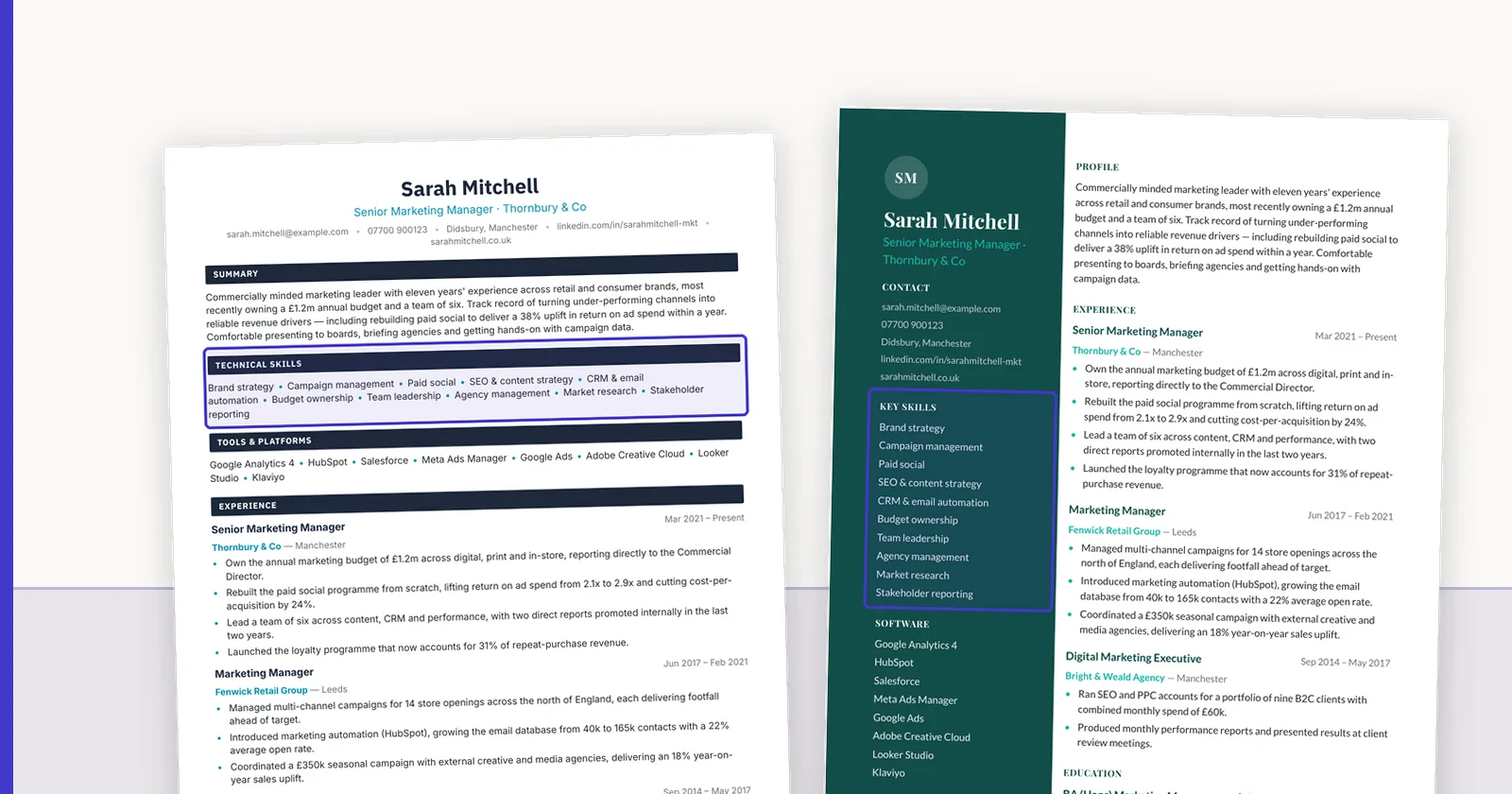
On a standard UK CV the skills section sits after your profile and before your experience, or directly after your experience if your recent roles are the stronger opening. Both work. What matters is that it is short: one block of five to ten skills, written as a plain list or a single line separated by bullets, readable in a couple of seconds.
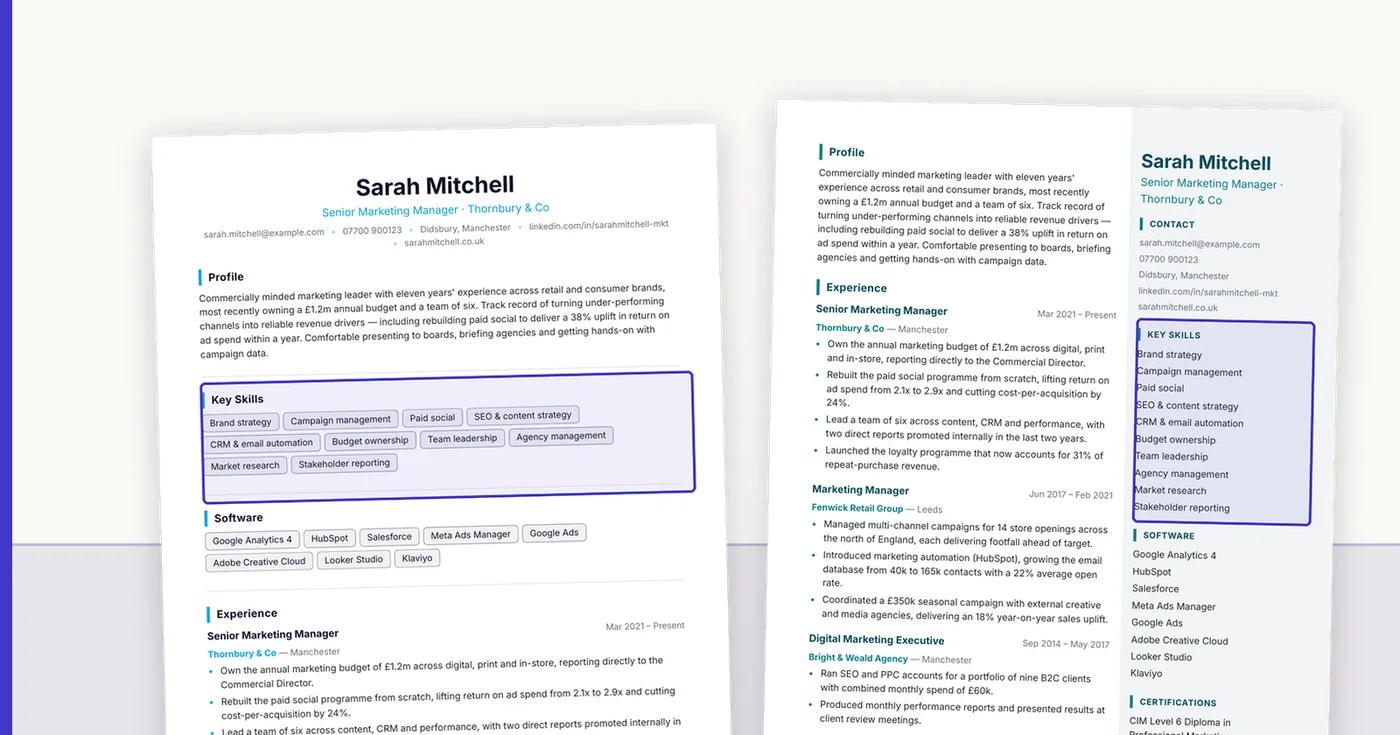
Keep it as text. Skill bars, star ratings and percentages look tidy and mean nothing: 80% Excel is not a fact anyone can check, and software reading your CV sees either nothing or a stray number. A recruiter who reformats CVs for clients will convert those graphics into a plain list anyway, as our piece on what recruiters change on every CV describes.
If you use a two-column layout, keep the skills in the main column for online applications. Sidebars can be read out of order by some software, which is why the ATS-friendly CV template guide recommends a single column when the CV goes through a form.
Skills section of CV example: tailoring it to an advert
Here is the method from the top of this guide applied to a real-looking advert. Imagine an operations coordinator role at a logistics firm asking for: strong Excel, experience with a warehouse management system, scheduling deliveries, dealing with suppliers and drivers, problem solving under time pressure, and a full UK driving licence.
Our fictional applicant, Dan, has spent four years as a shift supervisor at a supermarket depot. His old skills section read: 'Hard-working, team player, good communicator, Microsoft Office, leadership, attention to detail, punctual.' None of that is wrong, and none of it matches the advert.
Rewritten against the advert, it reads: 'Excel (rotas, delivery trackers, lookups) · Warehouse management system (daily use, goods in and dispatch) · Delivery scheduling · Supplier and haulier liaison · Shift supervision (team of 12) · Full UK driving licence.' His communication skills and leadership skills are no longer claimed in the list; they show up in the bullets. Every item is in the advert's language, every item is something he can talk about at interview, and every item reappears as a bullet in his experience: the tracker he built, the late-delivery problem he fixed, the team he ran.
Notice what went. 'Punctual' and 'hard-working' are expected of everyone. 'Attention to detail' is better shown by a bullet about stock accuracy. 'Team player' is shown by the supervision line. The new section is shorter and does far more work.
Skills for a CV with no work experience
School leavers, students and people returning after a long gap often think they have no skills to list. They usually have plenty; they just come from school, volunteering, caring, sport, clubs and projects rather than from a payslip. The rule is the same as for everyone else: name the skill, then prove it somewhere on the page.
Good sources of evidence are a Duke of Edinburgh award, a part-time or Saturday job, helping run a club or team, a school or college project, volunteering, looking after a relative, or anything you organised. 'Organised a charity quiz night for 80 people, booking the venue and selling tickets' proves planning, communication and responsibility at once, and it is far more convincing than the three words on their own.
Keep the list short, put your education first, and use the graduate CV templates, which are laid out for CVs that lead with study and projects rather than a long work history.
A skills-based CV format: when it helps and when it backfires
A skills-based CV layout (also called a functional CV) organises your experience under skill headings rather than by job, with a short employment list at the end. It suits genuine career changers, people returning after a long gap and people whose transferable skills matter more than their job titles.
It backfires with most recruiters, who read a skills-based CV as an attempt to hide something, and with parsing software, which needs a job title next to an employer next to dates to understand your history. If you use one, keep a dated employment list on page one and make the skill sections specific. Our comparison of the five CV formats and who each suits sets out when a hybrid format is the better choice.
The skills sections recruiters delete
These come up constantly on CVs that pass across a recruiter's desk, and each one costs the space it takes.
- A list of twenty-plus skills with no priority
- Generic qualities with no evidence anywhere on the page: hard-working, reliable, team player
- Rating bars, stars and percentages
- Tools listed that you used once on a training course
- Skills that contradict the experience below them (advanced Python, but no role that used it)
- Skills that are simply assumed for the job, such as 'email' for an office role
Turning skills into evidence in your experience
The skills list gets you matched; the experience section gets you believed. For each key skill, find one bullet where it produced a result, and put the result first: what changed, by how much, for whom. 'Built a weekly Excel model that cut stock write-offs by a fifth' proves Excel modelling better than any rating could.
If you use AI to rewrite those bullets, check that it has not added a figure or a tool you never mentioned; models like to strengthen a sentence by inventing a number. Our guide to using AI on your CV without getting caught covers the checks.
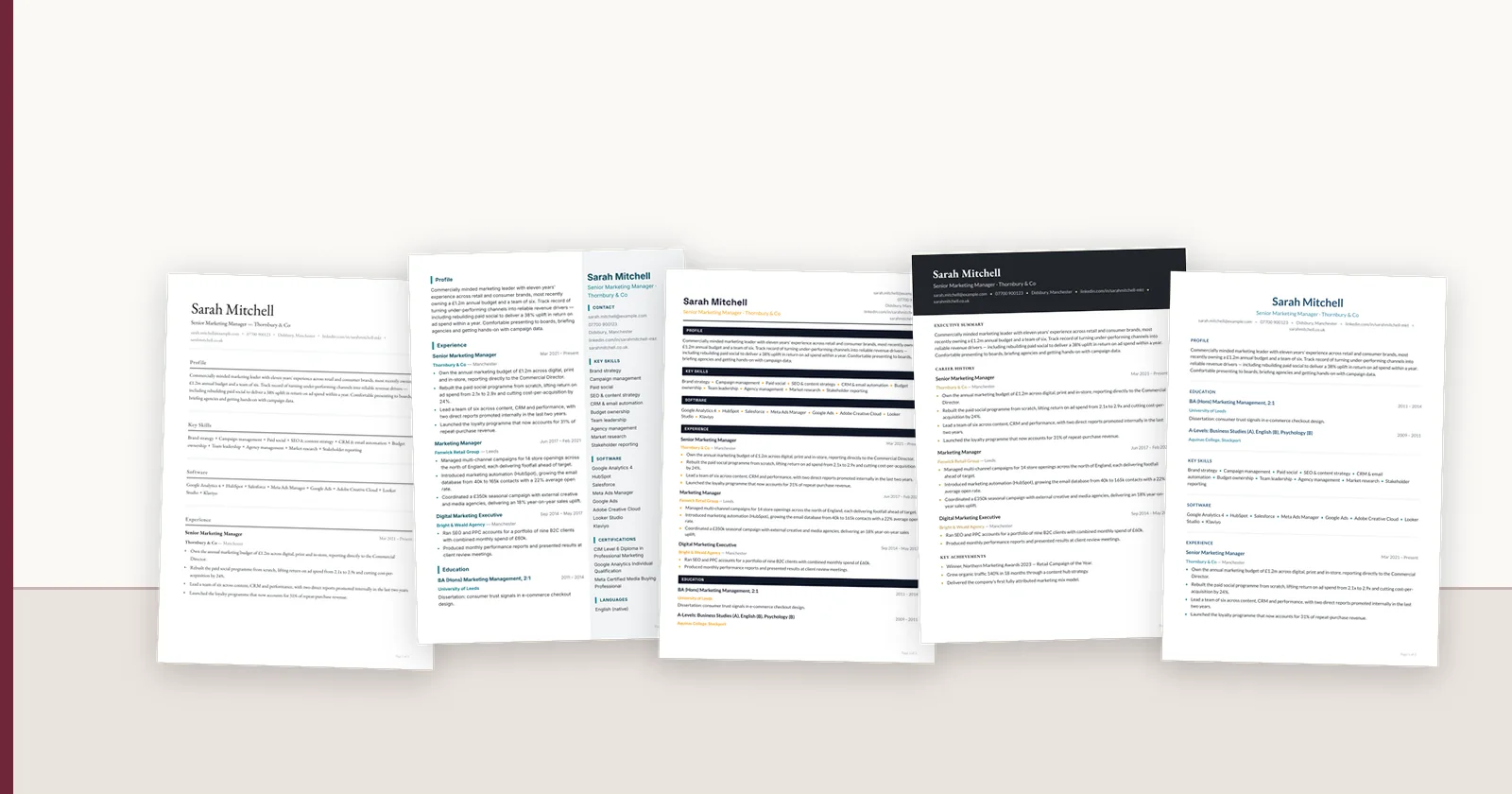
ConnectIQ reads your existing CV, shows you the skills it extracted beside where each came from on the page, and sets the same content in a clean layout from our CV templates. Your first conversion is free with no card, and the AI only changes wording if you ask it to.
FAQ
Q01What are some key skills to include on my CV?
The key skills for CV purposes are the ones the job advert asks for that your experience proves. For most roles that means the specific tools and qualifications the job needs (for example Microsoft Excel, Xero, a driving licence or a professional registration), plus two or three behavioural skills such as communication, problem solving or leadership, each backed by a result in your experience section.
Q02What can I write for skills on my CV?
Write the specific skills the advert names that you can prove: tools and software you use, qualifications and licences, and two or three behavioural skills such as communication or organisation. Then make sure each appears working in a bullet in your experience, so the skills list for CV readers is backed by evidence.
Q03How many skills should I put on my CV?
Five to ten in the skills section is enough for most CVs. Fewer, well-chosen skills that are each proved further down the page are more convincing than a long list nobody can verify.
Q04What are soft skills for a CV?
Behavioural skills such as communication, teamwork, problem solving, leadership, adaptability, time management and attention to detail. There is no official list of seven or ten; pick the ones the advert values and show them in your achievements rather than only naming them.
Q05What are examples of hard skills?
Checkable, teachable skills: a programming language, Excel modelling, bookkeeping software, a foreign language, a forklift or driving licence, a CSCS card, a first aid certificate, Google Analytics, Salesforce. List them by name, exactly as the advert does.
Q06Where should the skills section go on a CV?
Usually after your profile and before your experience, or straight after your experience if your recent roles make the stronger opening. Keep it short and in the main column, as plain text rather than bars or ratings.
Q07Should I use a skills-based CV?
Only for a genuine career change or a long gap, and even then keep a dated employment list on page one. Most recruiters distrust skills-based CVs, and software struggles to read them because skills are detached from employers and dates.
Q08Is it OK to list skills I am still learning?
Yes, if you label them honestly, for example 'Python (beginner, currently studying)'. Never present a skill at a level you could not demonstrate at interview; that is the fastest way to lose an offer.
Q09What are 10 basic skills for a CV?
There is no official list of ten. A useful starting set is the eight essential skills in the Skills Builder Universal Framework (listening, speaking, problem solving, creativity, adapting, planning, leadership and teamwork) plus basic digital skills and any licence or qualification the job needs. List the ones the advert asks for and prove each in your experience.
Q10What are transferable skills on a CV?
Skills that carry from one job or part of life to another, such as organising, explaining things clearly, handling complaints or managing time. They matter most for career changers and school leavers. Name them in the advert's words and back each one with something you actually did.
Q11How do I describe computer skills on a CV?
Name the specific software and say what you did with it, for example 'Excel: weekly stock report using lookups and pivot tables'. Avoid 'proficient in Microsoft Office'. Leave out basics such as email unless the advert asks for them.
Q12Should I put language skills on my CV?
Yes, if you can use the language at work. Give a level for each one, such as native, fluent or a CEFR level like B2, so the employer knows what to expect. Do not list a language you could not hold a conversation in.
ConnectIQ Editorial documents practical recruitment operations and the controls implemented in the ConnectIQ product. This guide is general operational information, not legal advice.