How Long Should a Resume Be? One Page, Two Pages, and the Federal Two-Page Rule
The honest answer to how long a resume should be depends on how much relevant experience you have, not on a rule. Here is the one-page versus two-page decision, the federal two-page limit, and what to cut first when you are over.
How long should a resume be? For most US job seekers, one page if you have under about ten years of relevant experience, and two pages if you have more, or if your field expects detail on projects, publications or certifications. Federal jobs are now stricter: since September 27, 2025, resumes for most federal positions on USAJOBS are limited to two pages. Academic CVs are the exception that can run much longer. The rest of this guide explains how to decide between a one-page and a two-page resume, what to cut when you are over, and how layout choices change resume length more than people expect.
How many pages should a resume be? The short answer
A one-page resume suits students, recent graduates, career changers whose relevant experience is recent, and anyone with a short, focused history. Recruiters reading early-career resumes expect one page, and a second page padded with coursework or unrelated jobs works against you.
A two-page resume suits most people with substantial experience: mid-career professionals, managers, technical specialists with many projects or certifications, and anyone whose recent roles each need several bullets to explain. Squeezing ten or fifteen years onto one page by shrinking the font produces a resume that is harder to read, not a better one.
Three pages or more is rarely right for a private-sector resume. It is normal for an academic CV, and occasionally for very senior executive or technical roles where the posting asks for detail, but treat it as the exception.
If you need a one-page resume template in Word, any single-column layout in our resume templates exports to Word as well as PDF.
Resume length by career stage
The years are a guide, not a cutoff. The real test is relevance: if a hiring manager would skip a line, it should not be making the resume longer.
- Student or new graduate: one page. Education near the top, internships, part-time work and projects with results.
- Early career (roughly 1 to 5 years): one page in most cases. Two only if every line is relevant to the job.
- Mid-career (roughly 5 to 15 years): two pages is normal. The last ten years in detail, older roles compressed.
- Senior and executive: two pages, occasionally more if the posting asks for board, acquisition or publication detail.
- Career changer: one page that leads with transferable results, plus a short dated history.
- Academic and research: a CV, which can run many pages because publications, grants and teaching are listed in full.
Resume length at a glance
The table pulls the guidance together. Treat the numbers as a starting point for judgment, not a rule a recruiter is checking; the only hard limit in this article is the federal one.
| Situation | Pages | Roles in full detail | Bullets on most recent role |
|---|---|---|---|
| Student or new graduate | 1 | Internships, part-time work, projects | 2 to 4 |
| Early career (1 to 5 years) | 1, sometimes 2 | All roles | 3 to 5 |
| Mid-career (5 to 15 years) | 2 | Last 10 years | 4 to 6 |
| Senior manager or executive | 2, occasionally 3 | Last 10 to 15 years | 5 to 6 |
| Career changer | 1 | Roles with transferable results | 3 to 5 |
| Federal job on USAJOBS (Title 5) | 2 maximum | As many as fit two pages | Varies; include hours per week |
| Academic or research CV | No fixed limit | Full record | Not bullets; full listings |
Resume length by industry
Career stage matters more than industry, but fields do have habits worth knowing.
Technology and engineering. Two pages is common for experienced engineers because projects, stacks and certifications take space. Keep the tools list tight and let the bullets show which tools you used for what. A link to GitHub or a portfolio can carry detail the page does not need to.
Healthcare. Clinical resumes often run to two pages once licenses, certifications and clinical rotations are listed. Keep every license number and expiry accurate; that section is checked, not skimmed.
Education. Teachers usually fit on one or two pages; certifications, endorsements and grade levels belong near the top. A university teaching or research post is a different document, an academic CV, with no fixed length.
Sales and business development. One page is common even for experienced people, because the resume is mostly a list of numbers against quota. If you go to two pages, page one must show your best results.
Skilled trades. One page usually works: licenses, certifications, the types of project and a clean safety record matter more than long bullets.
Creative roles. One page with a portfolio link. The portfolio does the showing; the resume only needs to make someone click it.
Executive roles. Two pages, sometimes with a short board or acquisitions addendum if the posting asks for it. Executive recruiters still expect the first page to stand alone.
Federal resumes: the two-page limit
Federal hiring changed in 2025. According to the US Office of Personnel Management's guidance on the two-page resume limit, starting September 27, 2025, USAJOBS restricts resumes to two pages for competitive and excepted service announcements under Title 5. That includes resumes stored in a USAJOBS profile, uploaded resumes and the resume builder.
The consequence is strict: OPM's guidance says that if the only resume an applicant submits is longer than two pages, the applicant is ineligible for further consideration. Some agencies outside Title 5, and judicial and legislative branch agencies, can accept longer resumes, but only if the job announcement says so and explains how. Read the How to Apply section of each announcement before you submit.
Older advice that federal resumes should run four or five pages is now out of date for most positions. Federal resumes still need specific details, such as hours per week and month-and-year dates for each role, so the two-page limit means cutting older and less relevant material hard.
Is a two-page resume okay?
Yes, when the second page carries real evidence. Most recruiters are comfortable with a two-page resume for an experienced candidate; what they dislike is a second page with three lines on it, or one filled with old roles and generic skills.
If you go to two pages, make the first page do the work on its own. Put your name and contact line, summary, and most recent roles on page one, so a reader who stops there still sees why you fit. Add your name and page number to page two in case the pages are separated when printed.
How long should each part of a resume be?
Resume length is the sum of its parts, so most length problems are really one section that has grown too long. These are reasonable targets for each part:
- Header: two lines at most. Name, then city and state, phone, email and one link.
- Summary: three or four lines, roughly 40 to 70 words. Our resume summary examples show how to fit a title, two strengths and a result into that space.
- Each bullet: one or two lines. A bullet that wraps to a third line usually contains two ideas; split it or cut one.
- Bullets per role: three to six for the most recent roles, one to three for older ones, none for roles in an "Earlier experience" line.
- Skills: one to four lines of relevant tools and methods. A skills section that runs longer than your summary has usually become a keyword list.
- Education: one or two lines per qualification. Coursework, GPA and honors only in the first few years after graduating, and only if they help.
- Certifications, projects, volunteering: one line each unless the job is specifically about them.
How to cut a resume to one page or two
Cut content before you touch the font size or margins. The order below removes the least valuable material first.
- Delete an objective statement if you have one, and keep the summary to three or four lines.
- Compress roles older than 10 to 15 years into one line each: title, employer, years.
- Cut duty bullets ("responsible for") and keep result bullets with numbers.
- Remove "References available on request", hobbies that add nothing, and a full street address.
- Combine short contract roles under one heading.
- Only then adjust layout: margins no smaller than about 0.7 inch and body text no smaller than 10 points.
A worked example: cutting two pages to one
Here is how the cutting order plays out on a fictional resume. Sam Torres is a marketing coordinator with four years of experience applying for a role that expects one page, and the draft runs to a page and a third.
First pass, content: the objective statement goes (three lines saved). The summary is trimmed from six lines to four (two lines). A part-time college job from six years ago drops to one line with no bullets (three lines). Two duty bullets, "Responsible for the social media calendar" and "Assisted with events", are cut because the results bullets above them already show that work (two lines). "References available on request" goes (one line).
Second pass, structure: the skills section had three lines of tools, ten of which never appear in the job posting. Trimming to the relevant ones saves two lines. Education moves below experience and loses the coursework list (three lines).
That is sixteen lines, roughly a third of a page, without touching the font or margins. Sam's resume now fits on one page at 11-point body text with normal margins, and everything that was cut was either duplicated elsewhere or irrelevant to the job.
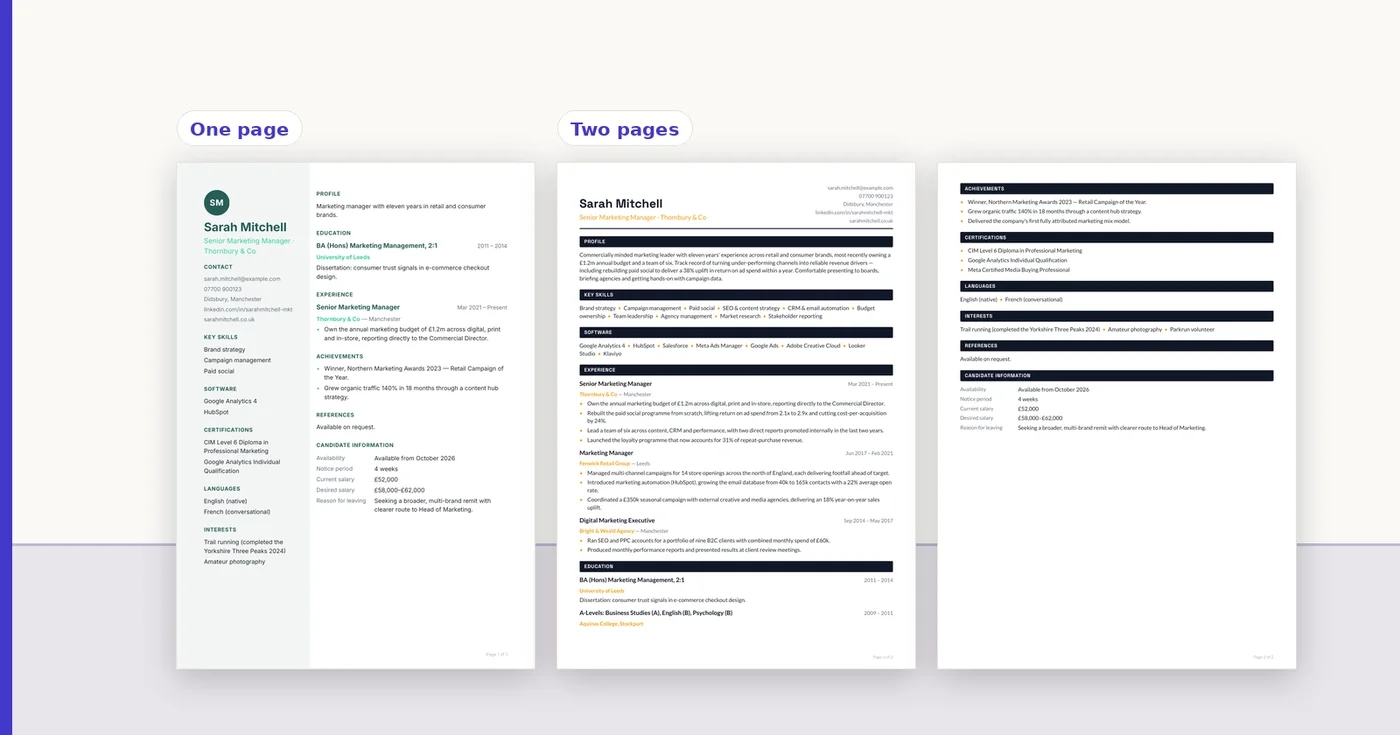
If you are still over after both passes, try a more compact layout before you shrink the type. A wide sidebar or an oversized header can cost five or six lines on its own.
Resume length for contractors, temps and career moves
Contractors and temporary workers often have the longest resumes, because every assignment gets its own entry. Group short assignments instead: one heading such as "Contract assignments, 2021 to 2024" with the client names and two or three combined results underneath. If you worked through a staffing agency, list the agency as the employer and the client sites in the bullets. Either way, the timeline stays readable and the page count drops.
If you are moving from federal to private-sector work, the reverse applies. A federal resume carries details private employers do not need, such as hours per week, grade levels and supervisor contact lines. Strip those out and you will usually find a two-page federal resume becomes a tight one or two pages for a company application.
Moving from an academic CV to an industry resume is the biggest cut of all: publications, conference talks and teaching lists shrink to a short selection that supports the job, and the resume usually lands at two pages.
Changing careers is the one case where a shorter resume often does better than a longer one. A focused one page that leads with transferable results reads as intentional; two pages of an unrelated history make the reader do the translation.
Layout changes length more than you think
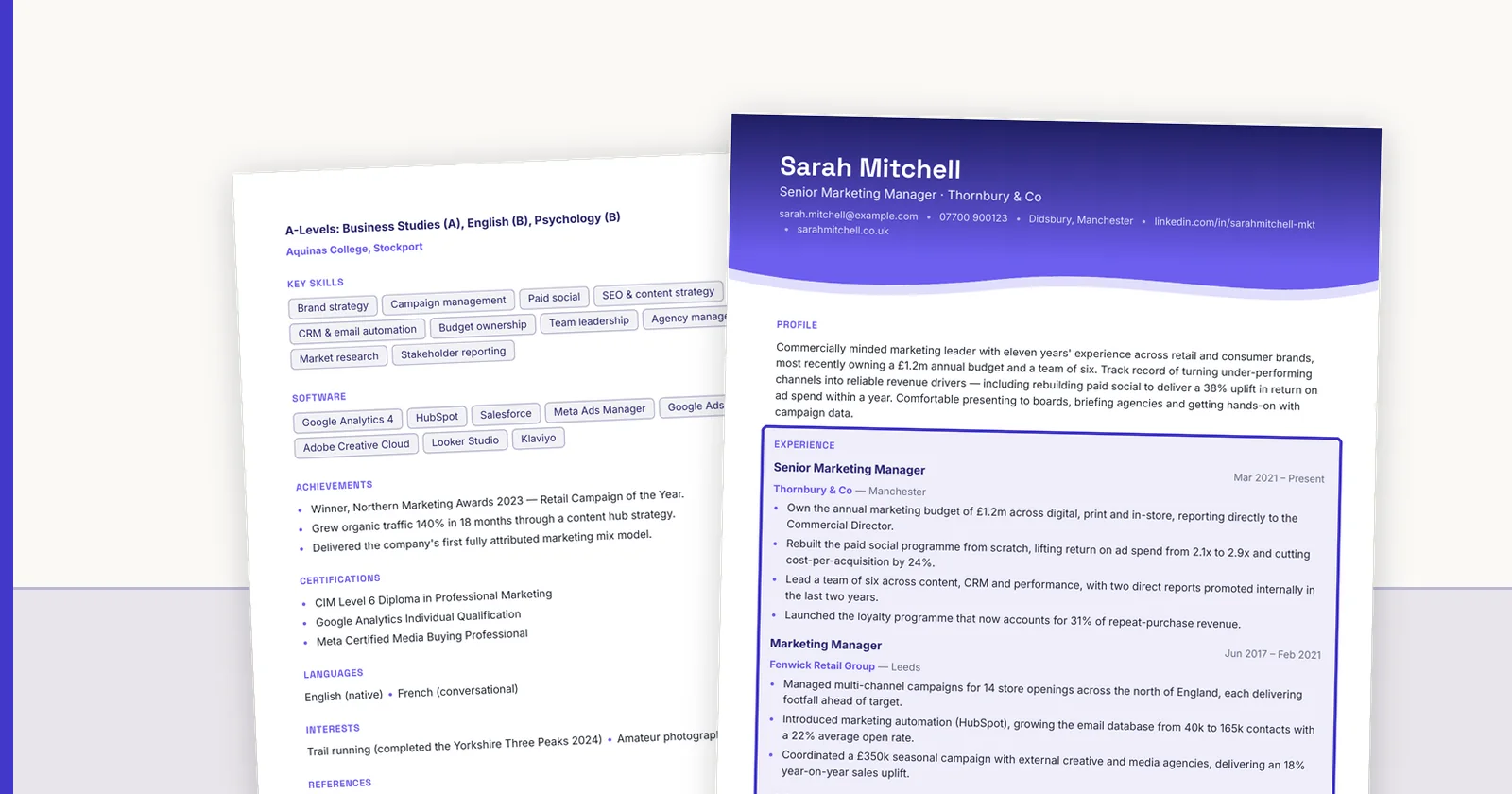
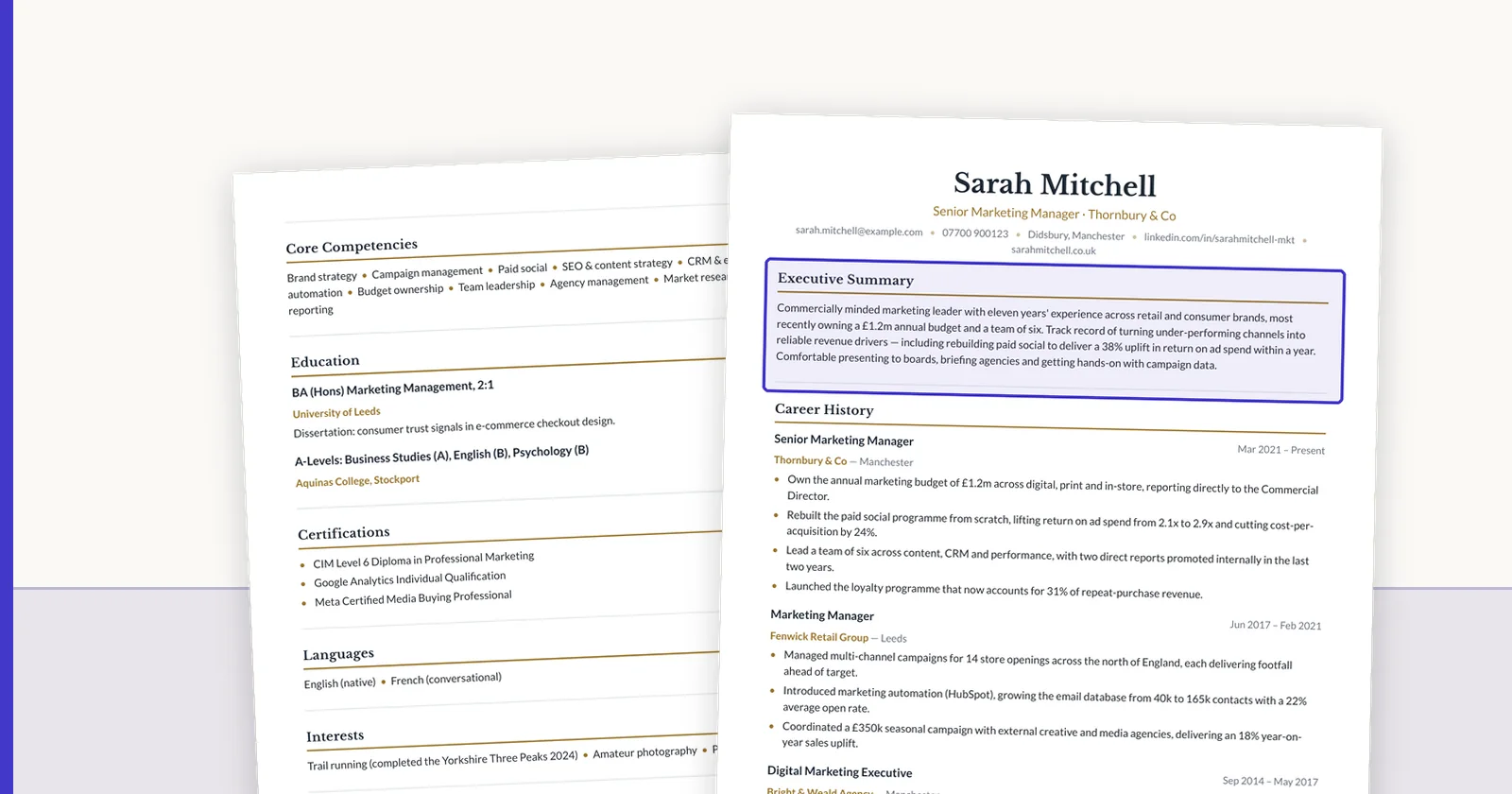
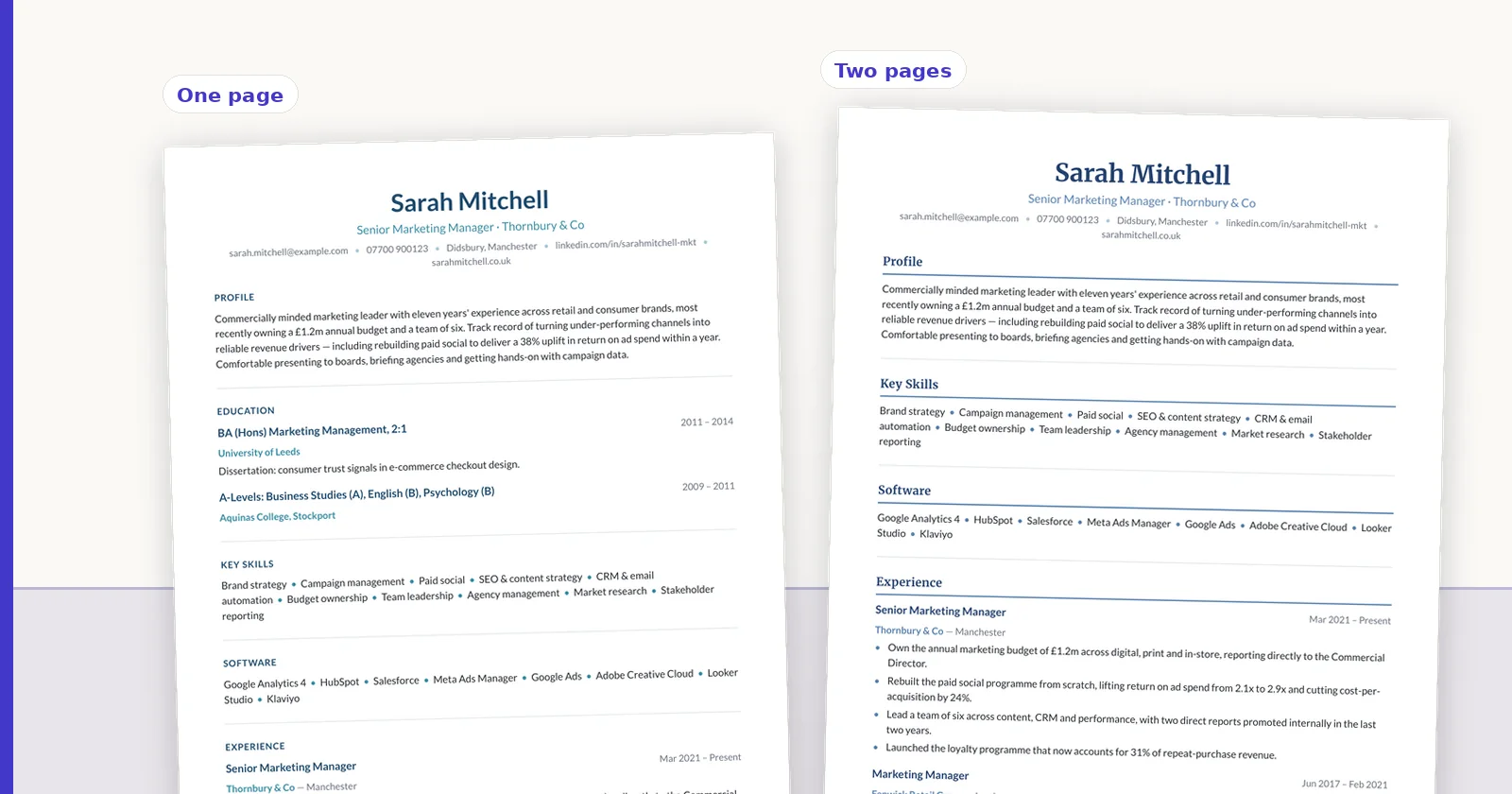
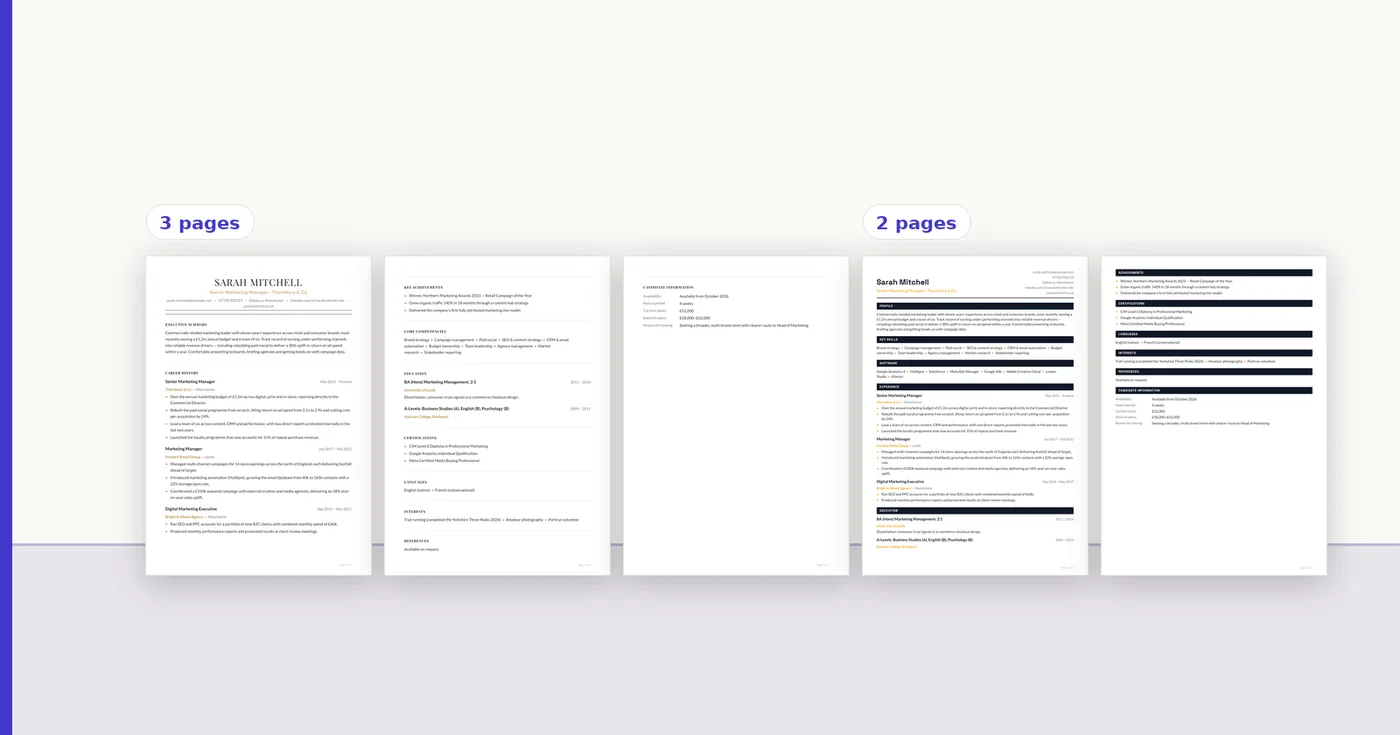
The same content can run to one page or two depending on layout. Wide sidebars, large headers and generous spacing push content onto a second page; a compact single column with dates aligned on the right of each job line fits more without looking crowded. That is the honest difference between a one page resume template for Word and a two page resume template for Word: the spacing, not a different set of rules.
That is one reason to try your resume in a few layouts before cutting good material. ConnectIQ sets the resume you already have in any of 57 resume templates, so you can see whether a more compact layout brings you back to one page or two, then export PDF and Word from the same version. Your first conversion is free with no card.
For the structure that keeps length under control, see the reverse-chronological resume; for the top of the page, resume summary examples; and for doing it by hand, how to format a resume in Word.
Page breaks and the second page
A two-page resume has one more thing to get right: where page one ends. A job title stranded at the bottom of page one with its bullets on page two looks careless and is easy to miss.
In Word, select the job title line, right-click and choose Paragraph, then on the Line and Page Breaks tab tick Keep with next. The title will then always move with its first bullet. Do the same for section headings. Our guide to formatting a resume in Word covers the rest of the settings.
Put your name and a page number in small type at the top of page two, so a printed copy that gets separated can be put back together. Then check the PDF, not just the Word file, because a different printer or font can move the break.
FAQ
Q01Can a resume be two pages?
Yes, for most experienced candidates. Make sure page one works on its own and the second page carries real evidence rather than old roles or generic skills.
Q02Is a three-page resume too long?
For most private-sector jobs, yes. Three pages is normal for an academic CV and occasionally for senior roles where the posting asks for detail. For federal jobs on USAJOBS under Title 5, resumes over two pages are not considered.
Q03How long should a resume be for a first job?
One page. Lead with education, then part-time work, internships, projects and volunteering, each with a result where you can.
Q04Should I shrink the font to fit one page?
Only slightly. Body text below about 10 points and margins under about 0.7 inch make a resume harder to read. Cut older and less relevant content first.
Q05Do federal resumes have a page limit?
Yes. Under OPM guidance, from September 27, 2025, USAJOBS limits resumes to two pages for Title 5 competitive and excepted service announcements, and an applicant whose only resume is longer is ineligible. Check each announcement for exceptions.
Q06Is a one page resume template better?
Only if your experience fits on one page without cramming. A compact single-column template can save space, but the right length comes from your content, not the template.
Q07How long should a resume be in 2026?
The same as before for private-sector jobs: one page for early career, two for most experienced candidates. The change in 2026 is federal hiring, where USAJOBS now enforces a two-page maximum for Title 5 announcements, so older advice about long federal resumes no longer applies.
Q08Do recruiters read the second page of a resume?
Often, but only if page one has convinced them to keep going. Put your strongest, most recent evidence on page one and use page two for earlier roles, certifications and supporting detail.
Q09How many bullet points should each job have on a resume?
Three to six for your most recent roles and one to three for older ones. Each bullet should be one or two lines and describe a result, not a duty. Roles from more than 10 to 15 years ago can be a single line with no bullets.
Q10How long should a resume summary be?
Three or four lines, roughly 40 to 70 words. It should name your role and experience level, two relevant strengths and one result, and nothing that the job history below does not support.
Q11How many words should a one-page resume have?
There is no official count, but a one-page resume in a single column at 10 to 11 point type usually holds somewhere around 400 to 650 words. If you are far above that, the page will look crowded; cut content before shrinking the type.
ConnectIQ Editorial documents practical recruitment operations and the controls implemented in the ConnectIQ product. This guide is general operational information, not legal advice.