Resume Summary Examples: 45+ Professional Summaries and the Formula Behind Them
A resume summary is the three or four lines under your name that tell a recruiter what you are and why you fit. Here is the formula, more than 45 examples by role, industry and career stage, and the mistakes that make a summary read like filler.
A resume summary is a short professional summary, usually three or four lines, at the top of your resume that states what you do, how much experience you have, and the result you are best at. A good example of a summary for a resume names a specific role, a scope and one piece of evidence; a weak one lists adjectives that would fit anyone. Below is a simple formula, more than 45 resume summary examples across roles, industries and career stages, and the questions people ask most about what to put in a summary on a resume.
What a resume summary is for
What is a resume summary? It is the short paragraph, sometimes called a summary statement or a profile summary for a resume, that sits under your name. Recruiters scan the top third of a resume first. The summary is the only part of that space you write in your own voice, so its job is narrow: tell the reader what kind of professional you are and why the rest of the page is worth reading. It is not a biography and it is not a list of personality traits.
A resume with a professional summary works best when the summary and the first job agree. If the summary says you lead product teams, the first role underneath should show you leading a product team. When the two disagree, the reader trusts the job history and discounts the summary.
Summaries have largely replaced the old objective statement. An objective says what you want; a summary says what you offer. Hiring managers care about the second.
If you are wondering how to do a resume summary quickly, start from the formula below and the professional summary ideas in the examples, then cut anything that could describe someone else.
Resume summary vs objective vs qualifications summary
Three different blocks can sit at the top of a resume, and people use the names loosely. The difference matters because each one answers a different question for the reader. A professional summary answers "what are you?", an objective answers "what do you want?", and a summary of qualifications answers "can you do the specific things this job needs?"
For most experienced candidates the professional summary is the right choice. A qualifications summary, usually four to six bullets, suits roles with hard requirements such as licenses, clearances or named software. An objective is now rare and only earns its space when the reader would otherwise be confused about why you are applying.
| Professional summary | Summary of qualifications | Resume objective | |
|---|---|---|---|
| Answers | What kind of professional you are and what you offer | Whether you meet the job's specific requirements | What job you want and why |
| Format | Three or four lines of prose | Four to six short bullets | One or two sentences |
| Best for | Most candidates with a few years of experience | Licensed, certified or technical roles; federal and public-sector jobs | Career changers, first jobs, a move the reader would not expect |
| Typical length | 40 to 70 words | 50 to 90 words | 20 to 40 words |
| Main risk | Generic adjectives with no evidence | Repeating the skills section word for word | Talking about yourself instead of the employer's need |
The formula: how to write a resume summary
Most strong summaries follow the same three-part shape, and you can write one in ten minutes once you see it.
Keep it to three or four lines, write it without "I", and use the job title language from the posting you are applying for where it honestly matches your experience. That last part matters for applicant tracking systems, which index the words on the page, and for the recruiter searching their database later.
Order matters as much as content. Recruiters often skim only the first line before moving to the job history, so the first five or six words should carry your title and your field. "Registered nurse with eight years in emergency care" works on a skim; "Dedicated and compassionate healthcare professional" does not.
- Line 1: who you are. Job title or field, years of experience, and the kind of organization you work in.
- Line 2: what you are best at. Two or three specific strengths, ideally the ones the job posting asks for.
- Line 3: proof. One result with a number you can explain in an interview, or a credential that matters for the role.
- Optional line 4: what you want next, only if it adds information, such as a move into management or a new industry.
Before and after: fixing a weak resume summary
Most summaries are not wrong so much as empty. The quickest way to learn the formula is to watch it applied to a draft that sounds fine and says nothing. Each pair below is for a fictional candidate; the "after" version uses only facts the candidate already had elsewhere on the page.
Operations, before: "Hard-working and results-driven operations professional with excellent communication skills and a passion for continuous improvement." After: "Operations supervisor with six years in third-party logistics, running a 40-person night shift across two warehouses. Strongest at slotting and labor planning. Cut mis-picks by a third in 2025 by redesigning the pick path." The first version contains four claims nobody can check; the second contains a title, a scope and a result.
Teacher moving into training, before: "Passionate educator seeking to leverage my skills in a corporate environment." After: "Middle school teacher with eight years designing curriculum for 120 students a year, moving into corporate learning and development. Builds short, assessed modules and adjusts them from the results. Led the district's onboarding sessions for new teachers in 2024 and 2025." The objective became a summary by naming the transferable work instead of the wish.
Software engineer, before: "Experienced full-stack developer proficient in many technologies including JavaScript, React, Node, Python, SQL, AWS, Docker and Kubernetes." After: "Full-stack engineer with five years building internal tools for finance teams in React and Node. Comfortable owning a feature from database to deployment on AWS. Rebuilt the expense approval app used by 3,000 employees." A list of tools belongs in the skills section; the summary picks the two that matter and shows them working.
Healthcare administrator, before: "Detail-oriented team player with a proven track record of success in fast-paced healthcare settings." After: "Practice manager with nine years running outpatient clinics of up to 25 staff. Strong on revenue cycle, scheduling and payer credentialing. Brought claim denials down from 11% to 6% in eighteen months." Notice that the after versions are not longer. They are denser.
Resume summary examples by role
These professional summary examples are written for fictional people; treat each as an example of a professional summary for a resume, not a script. Use them for shape and tone, then replace every fact with your own. A summary that borrows someone else's numbers is worse than no summary.
Software engineer: "Backend engineer with six years building payment and billing services in Go and Python. Strongest at untangling slow, legacy systems and making them observable. Cut checkout latency by 40% at a mid-size e-commerce company by redesigning the order service."
Registered nurse: "Registered nurse with eight years in emergency and urgent care settings, including four as charge nurse on a 30-bed unit. Calm under volume, careful with handoffs, and comfortable training new graduates. BLS, ACLS and PALS certified."
Sales: "Account executive with five years selling SaaS to mid-market finance teams. Consistent at turning inbound demos into closed revenue and at building referral relationships with existing customers. Finished 2025 at 118% of quota."
Marketing manager: "Marketing manager with seven years in consumer retail, owning a $1.2M annual budget and a team of four. Known for rebuilding paid social around measurable return rather than reach. Grew email revenue 30% in a year by fixing segmentation."
Project manager: "PMP-certified project manager with ten years delivering construction and fit-out projects up to $15M. Strong on schedule recovery, subcontractor coordination and plain-English reporting to clients."
Customer service resume summary: "Customer service lead with four years in high-volume contact centers, handling phone, chat and email. Resolves escalations without passing them up the chain and coaches new agents on tone and process. Kept first-contact resolution above target for six straight quarters."
Administrative assistant: "Administrative assistant with five years supporting senior leaders in a 200-person professional services firm. Manages complex calendars, travel and board materials with very few errors, and is the person colleagues ask when a process breaks."
More professional summary examples by industry
If you need resume professional summary ideas for a field not covered above, this is the place to look. The examples above cover the most common roles. These extend the same formula across industries, so you can find something close to your own field. Every person and every figure is invented for illustration; the shape is what to copy.
Healthcare and care work
Medical assistant: "Certified medical assistant with four years in a busy family practice seeing 60 patients a day. Handles intake, vitals, injections and EHR charting accurately under time pressure. Trained three new assistants on the clinic's Epic workflows."
Physical therapist: "Licensed physical therapist with seven years in outpatient orthopedics and sports rehabilitation. Builds plans patients actually follow, with clear home programs and progress tracking. Board-certified orthopaedic clinical specialist (OCS)."
Social worker: "Licensed clinical social worker with six years in child welfare and family services, carrying a caseload of 25 families. Calm in crisis, thorough with documentation, and experienced in court testimony."
Education
Elementary teacher: "State-certified elementary teacher with five years in grades 2 and 3, including two years leading the grade-level team. Strong on reading intervention and classroom routines. Moved 18 of 22 students to grade-level reading in one year."
Academic advisor: "Academic advisor with four years supporting first-generation college students through enrollment, financial aid and major selection. Advises a caseload of 300 students and runs the orientation program for transfer students."
Finance and accounting
Staff accountant: "Staff accountant with three years in month-end close, reconciliations and AP for a $40M manufacturer. Accurate, fast in Excel and NetSuite, and the person who documents the process so the next close is quicker."
Financial analyst: "FP&A analyst with five years building budgets and forecasts for a multi-site healthcare group. Turns operational data into models leaders use for staffing and capital decisions. Built the rolling forecast that replaced a once-a-year budget."
Financial advisor: "Series 7 and 66 licensed financial advisor with eight years serving retirees and pre-retirees, managing relationships for 140 households. Known for plain-English planning and long client retention."
Technology and data
Data scientist: "Data scientist with four years in retail pricing and demand forecasting, working in Python and SQL. Strongest at turning a model into a decision a merchandising team will use. Shipped a markdown model now used across 300 stores."
UX designer: "Product designer with six years designing B2B software, from research through shipped interface. Runs usability studies and turns them into decisions engineers can build. Redesigned onboarding for a payroll product and cut support tickets for setup by half."
IT support: "IT support specialist with three years supporting 400 users across Windows, macOS and Microsoft 365. Resolves most tickets at first contact and writes the help articles that stop repeat calls. CompTIA A+ and Network+ certified."
Product manager: "Product manager with five years on consumer subscription apps, owning roadmap and pricing for a product with two million monthly users. Strongest at finding the one metric that matters and saying no to the rest."
Trades, logistics and operations
Electrician: "Licensed journeyman electrician with nine years in commercial new construction and tenant fit-outs. Reads drawings fluently, leads small crews, and has a clean safety record. OSHA 30 certified."
Warehouse supervisor: "Warehouse supervisor with five years running inbound and outbound teams of up to 30 in a high-volume distribution center. Strong on safety, scheduling and WMS accuracy. Forklift trainer and OSHA 10 certified."
Retail store manager: "Store manager with seven years in specialty retail, running a $4M store and a team of 22. Builds schedules around traffic, develops assistant managers into store managers, and keeps shrink below company target."
Creative, communications and legal
Graphic designer: "Graphic designer with five years in-house at a consumer brand, producing packaging, social and retail display work. Fast in the Adobe suite and careful with brand standards across agencies and printers."
Content writer: "Content writer with four years writing for B2B software companies, from blog posts to product pages and email. Interviews subject experts well and edits to a brief and a deadline."
Paralegal: "Litigation paralegal with six years in a mid-size firm, managing discovery, document review and trial binders for commercial cases. Experienced with Relativity and court e-filing in state and federal courts."
Sales and customer success
Customer success manager: "Customer success manager with five years in SaaS, owning a book of 60 mid-market accounts. Runs onboarding and quarterly reviews, and spots churn risk early from usage data. Held gross retention above 95% for two years."
Sales manager: "Regional sales manager leading eight reps across three states in industrial supplies. Coaches through ride-alongs and pipeline reviews rather than spreadsheets. Grew the region from fourth to first in the company over two years."
Resume summary examples by career stage
The formula stays the same as your career changes; the evidence you put in line three changes.
Recent graduate: "Accounting graduate (BS, 2026) with two summer internships in audit at a regional firm. Comfortable with Excel modeling and reconciliations, and preparing for the CPA exam. Looking for a staff accountant role in public practice."
Career changer: "Former high school science teacher moving into instructional design after nine years building curriculum for 150 students a year. Experienced in breaking complex material into short modules and measuring what learners retain. Completed a certificate in e-learning design in 2026."
Returning to work: "Operations coordinator returning after a three-year career break, with six earlier years running logistics for a regional distributor. Strong on vendor management and scheduling, and current on the shipping software used in the field."
Mid-career specialist: "Data analyst with seven years in healthcare, turning claims and clinical data into reporting that operations teams actually use. Fluent in SQL and Python, and good at explaining a finding to a non-technical audience."
Manager: "Engineering manager leading three teams and 20 engineers at a growth-stage fintech. Focused on hiring, delivery predictability and keeping senior engineers engaged. Reduced regretted attrition to zero over 18 months."
Executive: "Chief operating officer with fifteen years scaling operations in logistics and transportation, most recently across a 1,200-person organization. Led two acquisitions from diligence through integration. Board-facing, numbers-led, and comfortable with turnaround."
For more on laying out a senior resume around a summary like that last one, see our executive resume templates.
Resume summary examples for special situations
Some careers need the summary to do one extra job: explain something the reader would otherwise wonder about. Do it in a few words and move on; the summary is not the place for a long explanation.
Employment gap: "Payroll specialist with seven years processing multi-state payroll for up to 900 employees, returning after a two-year family caregiving break. Current on ADP Workforce Now and recent state tax changes through a 2026 refresher course."
Military to civilian: "Former Army logistics officer with eight years leading supply operations for units of up to 400, now moving into civilian supply chain management. Experienced in inventory accountability, vendor coordination and planning under tight timelines. Active Secret clearance." Translate ranks and acronyms into language a civilian recruiter uses; keep the clearance if it is current.
Freelancer or contractor: "Freelance copywriter with six years writing web and email copy for 30+ software and healthcare clients. Comfortable working to brief, turning drafts around quickly and working inside a brand's tone of voice. Moving into an in-house content role."
Internal promotion: "Senior accountant with four years at the company, currently running the close for two of five entities and training two staff accountants. Applying for the accounting manager role to take on the full close and team development." For an internal role, name the scope you already have; the panel knows the company.
Experienced candidate who does not want to signal age: "Operations director with extensive experience in manufacturing and distribution, most recently running three plants and 600 people." Saying "extensive" or "senior" instead of "30 years" is fine; pretending to be junior is not, and the job history will show the truth anyway.
Remote role: "Customer support lead with five years managing distributed teams across four time zones. Runs support through Zendesk and Slack, writes clear handover notes, and keeps response times steady without anyone in the same room." If the job is remote, show you already work that way.
A summary for a resume with no experience
A summary for a resume with no experience works the same way, but line three draws its proof from education, projects, volunteering or part-time work instead of a job history. Keep it to two or three lines, and make sure every claim is backed up further down the page.
Student: "Business administration student (BS expected May 2027) with a part-time retail job and two years as treasurer of a 60-member student organization. Comfortable with budgets, scheduling and handling customer questions. Looking for a summer internship in operations."
High school graduate: "Recent high school graduate with a year of weekend work at a family restaurant, handling the register, opening shifts and training two new hires. Reliable, punctual and quick to learn a new system."
Career changer with no direct experience: "Retail store supervisor moving into human resources, with four years scheduling a team of 15, handling hiring paperwork and resolving staff issues. Completed an HR fundamentals certificate in 2026."
The pattern is the same as every other example on this page: a specific identity, a relevant strength, and one fact a reader can check.
Tailoring one resume summary to two different jobs
A summary is the cheapest part of a resume to tailor: three lines, changed in five minutes, for each application. You are not inventing anything; you are choosing which true strengths to put first.
Here is one fictional candidate, a marketing coordinator with four years in a regional bank, applying for two jobs. For an email marketing role: "Marketing coordinator with four years in financial services, owning the bank's email program from segmentation to reporting. Strongest at testing subject lines and send times. Lifted email-driven account openings by a quarter in 2025."
For an events role: "Marketing coordinator with four years in financial services, planning 20+ customer and community events a year on fixed budgets. Strongest at vendor management and logistics under pressure. Ran the bank's largest client event, for 600 guests, in 2025."
Same person, same history, two different first impressions. Read the job posting, pick the two requirements you can prove best, and lead with those. If you find yourself needing a skill you do not have, that belongs in your cover letter as something you are building, not in the summary as something you already do.
What to write for a summary on a resume, and what to leave out
The fastest test is this: delete your name and read the summary aloud. If it could describe a thousand other people, it is not doing its job yet.
Numbers belong in a summary only if they are yours and you can explain how they were measured. An interviewer will ask about the most impressive figure on the page, and the summary is where it usually sits.
- Put in: your title or field, years of experience, the type and size of organization, two or three strengths the posting asks for, one result or credential.
- Leave out: adjectives with no evidence ("hard-working", "dynamic", "results-driven"), your age, family details, salary expectations, and anything you would not want to discuss in an interview.
- Avoid: copying the job posting word for word, writing in the first person, and repeating the same achievement that appears in your first job.
How to format a resume summary on the page
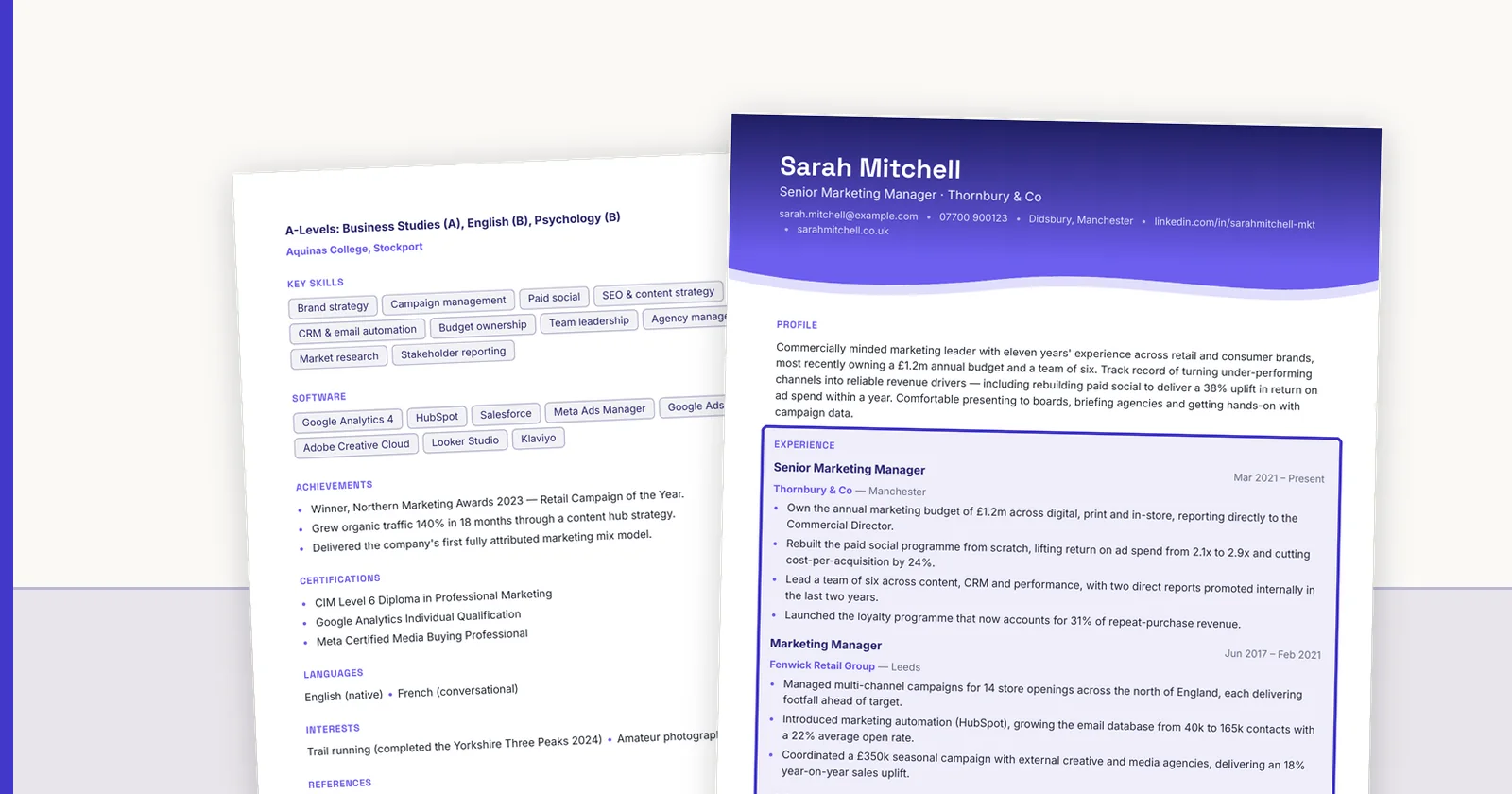
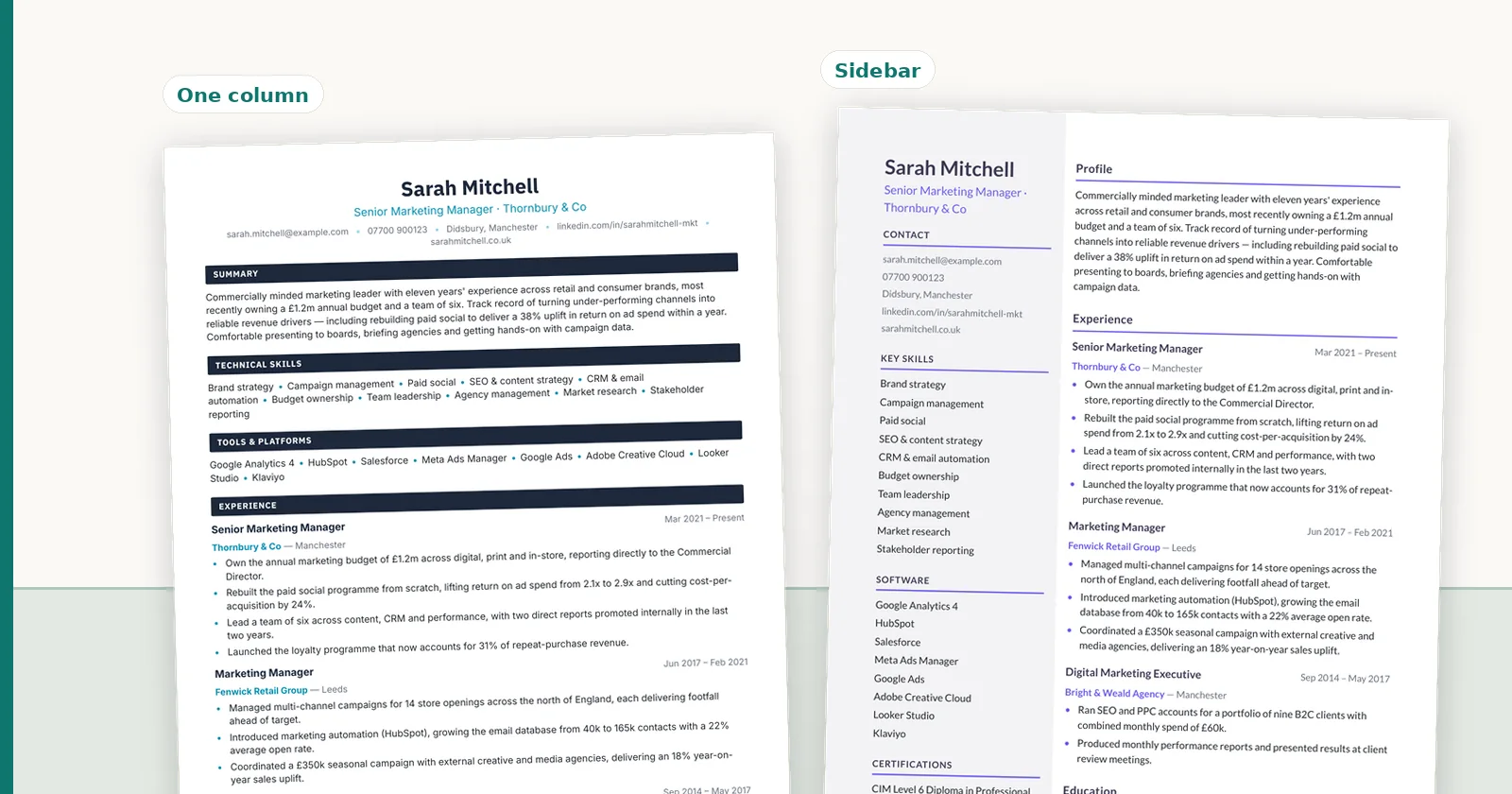
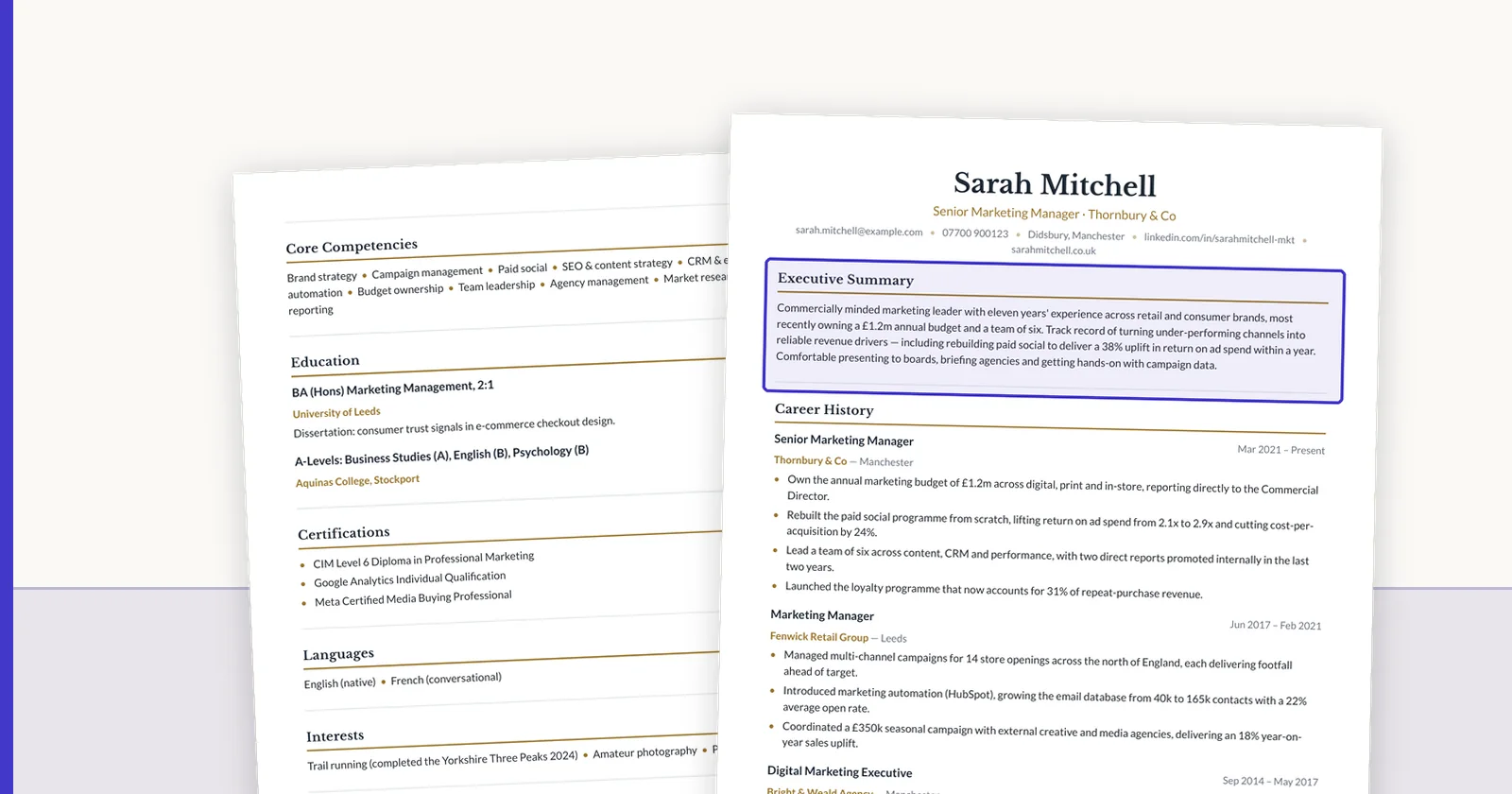
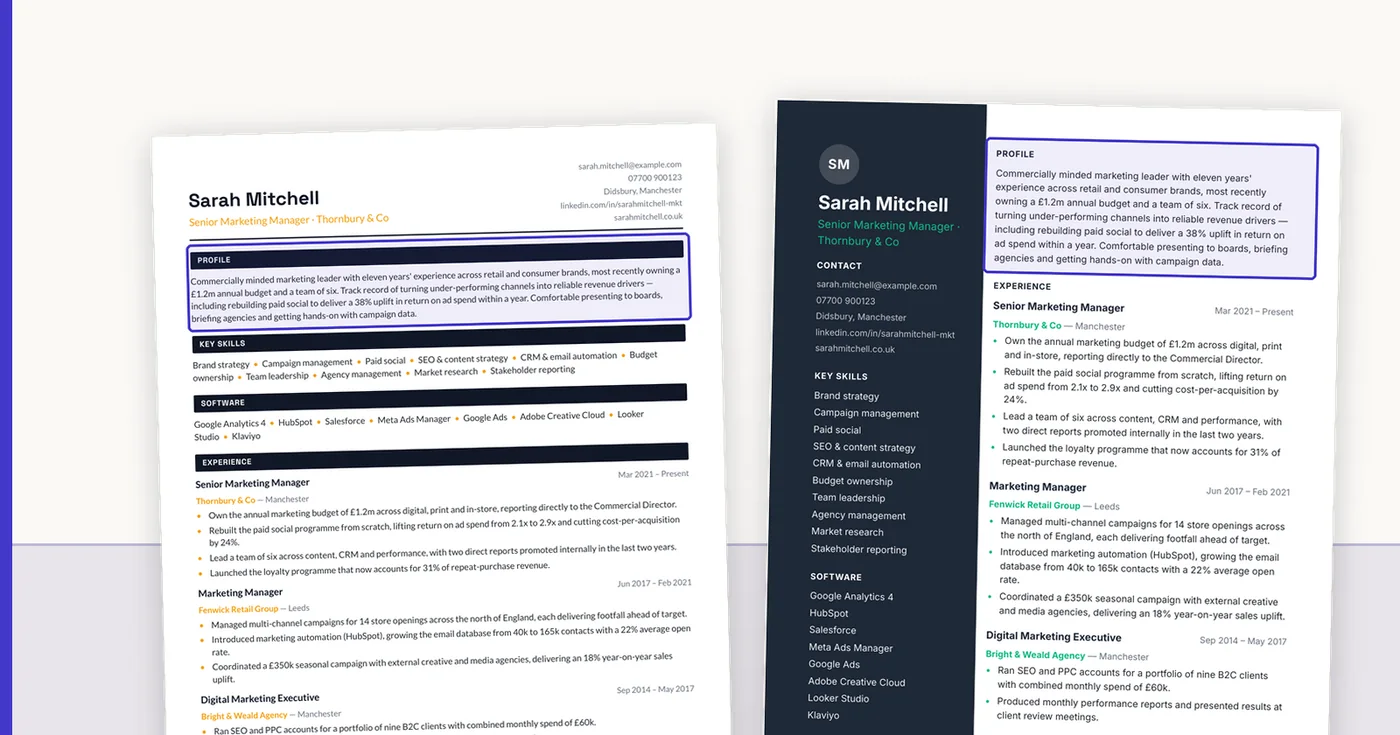
Put the summary directly under your name and contact line, above your work experience. A short heading such as "Summary" or "Professional Summary" is fine and helps an applicant tracking system label the section; some designs drop the heading and let the position do the work, which is fine for a human reader but slightly less clear to software.
Use the same font and size as the body text, not italics and not a box. Shaded boxes, text boxes and graphics often get skipped or scrambled when a resume is parsed, and the summary is the last place you want that to happen. For the full picture of what software reads, see what is an ATS resume?
If you have seen it called a resume summary statement or a profile summary on a resume, it is the same block, and the same rules apply. Keep it to one paragraph of three or four lines at your normal margins. If it runs to five lines, cut an adjective before you cut a fact. If you have a qualifications summary instead, four to six bullets is the ceiling, and none of them should repeat a bullet from your first job word for word.
Resume summary ideas when you are stuck
If a blank space at the top of the page is the problem, start from the evidence rather than the wording. Pull your three best results from the last five years onto a sheet, then ask which of them matches the job you want next. That result becomes line three, and lines one and two describe the person who could have achieved it.
Another approach is to read the summary of someone a level above you in the same field, on LinkedIn or a company website, and notice what they lead with. Borrow the structure, never the facts.
A good resume summary is usually rewritten several times. The first draft is too long, the second is too vague, and the third says one specific thing clearly. The best summary for a resume is rarely the cleverest one; it is the one a stranger could check against the jobs below it.
Using AI to write a resume summary
AI tools are good at tightening a summary you have already written and poor at writing one from nothing, because they do not know your numbers. Asked to make a summary more impressive, a model will often add a percentage or a scope that you never claimed. That is the single most common problem we see with AI-written resumes, and it is covered in detail in can your resume formatter invent a job?
ConnectIQ takes a different approach. You upload the resume you already have, choose how much the AI may change (from formatting only through to a full rewrite), and every change to your summary is shown as a before-and-after you approve. Employers, titles, dates and figures are checked against your original, and a rewrite that introduces a new number is rejected. Whether the reworded summary still means what you meant is your call, which is why the diff is there. Your first conversion is free with no card, and you can pick from our resume templates at the same time.
FAQ
Q01What should I include in my personal summary for my resume?
Your job title or field, years of experience, the type of organization you work in, two or three strengths the job posting asks for, and one result or credential you can explain in an interview. Three or four lines is enough.
Q02How long should a resume summary be?
Three or four lines, roughly 40 to 70 words. Longer summaries get skimmed, and anything beyond four lines usually repeats what your first job already shows.
Q03What is an example of a good summary for a resume?
"Account executive with five years selling SaaS to mid-market finance teams. Consistent at turning inbound demos into closed revenue. Finished 2025 at 118% of quota." It names the role, the scope, the strength and one result, and every part of it can be checked.
Q04Should a resume summary be written in the first person?
No. Standard practice is to drop "I" and write in short, implied-first-person sentences, such as "Marketing manager with seven years in retail." It reads more cleanly and saves space.
Q05Is a resume summary the same as an objective?
No. An objective says what you want from the next job; a summary says what you offer. Most recruiters now prefer a summary, and an objective is only worth including if you are changing careers and need to explain the move.
Q06Do I need a summary if I have little experience?
A short one helps, especially for a recent graduate or career changer, because it frames the education or transferable experience below it. Keep it to two or three lines and make sure every claim is supported further down the page.
Q07Does a resume need a summary?
Not always, but most do better with one. A summary helps when your recent title undersells you, when you are changing fields, or when a recruiter needs to see your level in three lines. With a short, obvious career history it can be cut. If you keep one, make every sentence specific to you.
Q08What to put on a summary on a resume?
Your job title or field and years of experience in the first line, two strengths the posting asks for in the second, and one checkable result or credential in the third. Leave out adjectives with no evidence, personal details and anything the job history below does not support.
Q09What is the 7 second rule in resume?
It comes from an eye-tracking study by the job site Ladders, which reported in November 2018 that recruiters spent an average of 7.4 seconds on an initial resume screen, up from about six seconds in its 2012 study. It measures the first skim, not a full read. The practical point is that your title, current role and summary need to make sense in that first look, which is why the summary should lead with a specific job title and field.
Q10How do I write a resume summary for a career change?
Lead with the work you have done that transfers, not the job title you are leaving. Name the new field in line one, show two transferable strengths with evidence, and add any training that bridges the gap. Example: "Former retail manager moving into HR, with five years hiring, scheduling and resolving staff issues for a team of 20. Completed an HR certificate in 2026."
Q11Should a resume summary have a heading?
Usually yes. A plain heading such as "Summary" or "Professional Summary" helps applicant tracking systems label the section and costs one line. Avoid creative headings such as "About Me" or "My Story", which some parsers do not recognize.
ConnectIQ Editorial documents practical recruitment operations and the controls implemented in the ConnectIQ product. This guide is general operational information, not legal advice.