The Reverse-Chronological Resume: Format, Template and Example
The reverse-chronological resume is the format most US recruiters expect. Here is what it is, the sections of a resume in the right order, an example you can follow, and the few cases where a different format makes more sense.
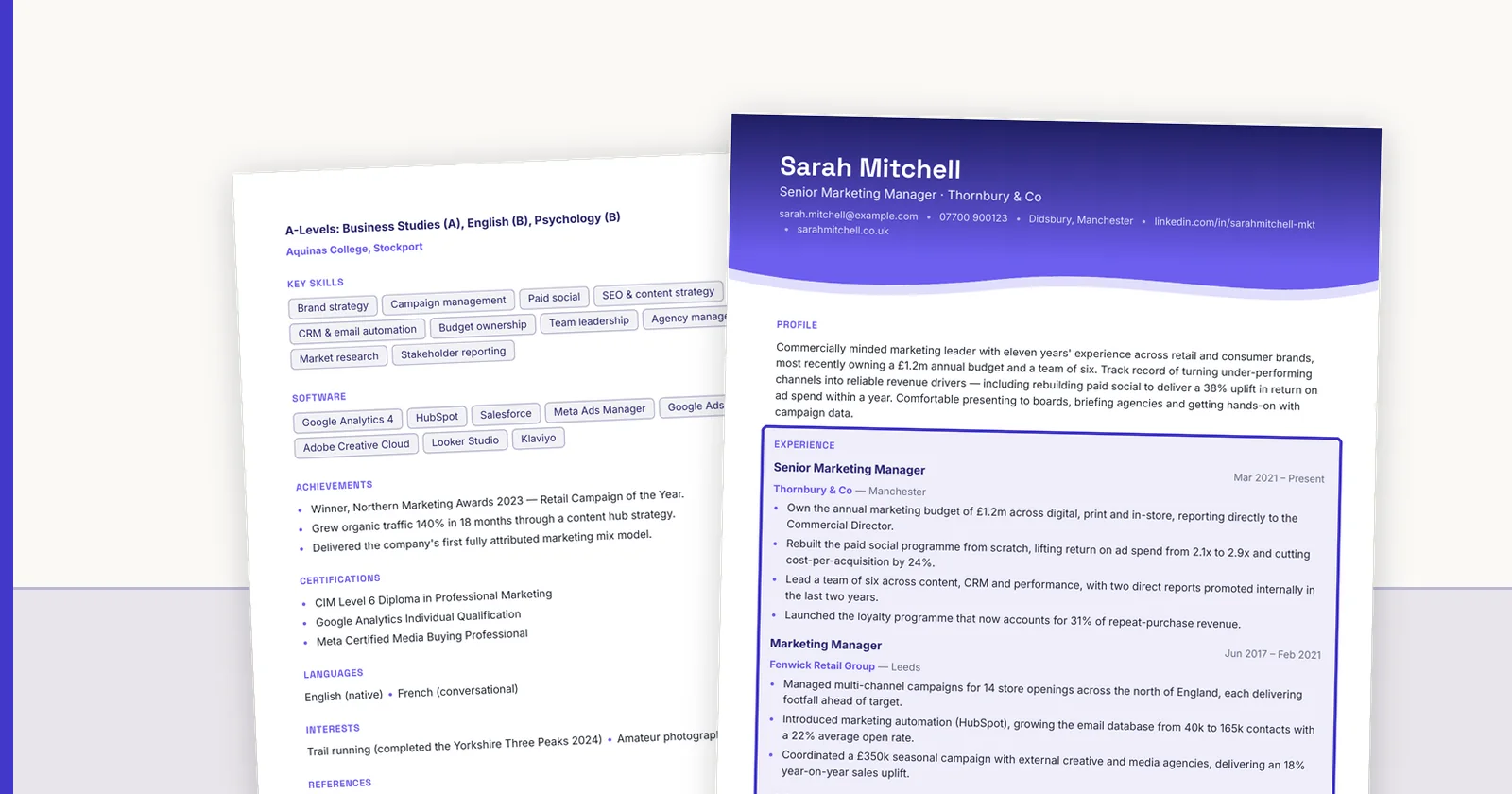
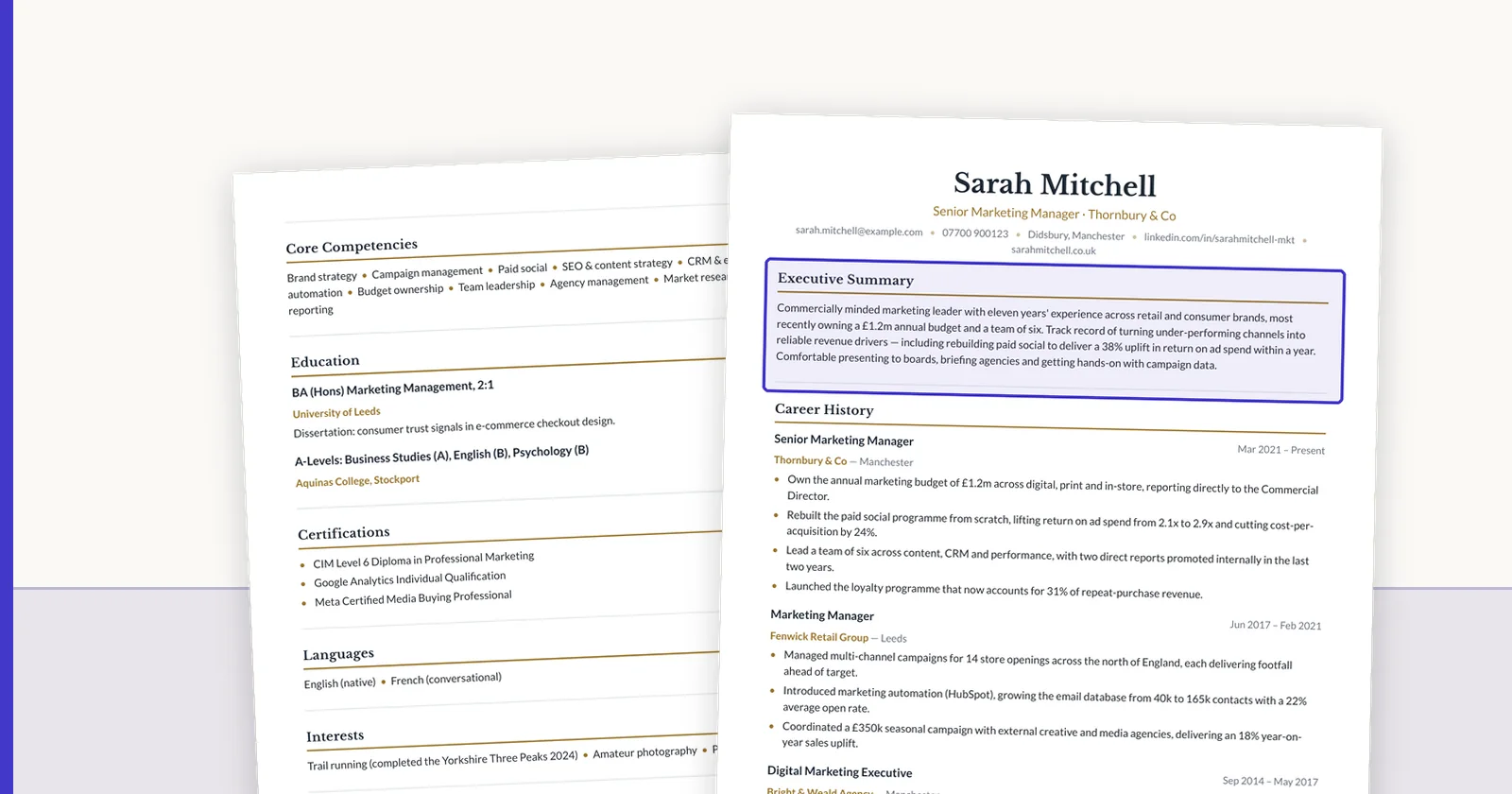
A reverse chronological resume lists your experience with the most recent job first and works backward, with dates on every role. It is the most common resume format in the US and the one recruiters and applicant tracking systems read most easily, because it answers the first question a hiring manager has: what are you doing now? This guide explains the reverse chronological resume format, lists the resume sections in order, gives a full example, and compares the chronological resume with functional and hybrid formats so you can tell when to use each.
What is a chronological resume?
In everyday use, a chronological resume and a reverse chronological resume mean the same thing: your work history arranged by date, most recent role at the top. Nobody lists their first job first, so "reverse" is often dropped. The definition that matters is that the structure follows your timeline rather than grouping experience by skill.
Reverse chronological order on a resume applies inside each section too. Your current or latest job comes first in Experience, your most recent degree first in Education, and the newest certification first in Certifications.
Order by the end date of each role, so the job you are in now (or left most recently) is at the top. If two roles overlap, put the one that ended later first, or the current one first if both are ongoing.
Resume sections, in order
These are the sections of a resume in the order a reverse-chronological layout uses them. Not every resume needs every section; the first four are standard and the rest depend on your field.
- Header: your name, then city and state, phone, email and a LinkedIn or portfolio link. No photo, date of birth or full street address.
- Summary: three or four lines on what you do, your experience level and one result. See resume summary examples for the formula.
- Experience: each job with title, employer, location and dates, most recent first, with three to six achievement bullets per recent role.
- Education: degree, school and graduation year (or expected year), most recent first. Move this above Experience if you graduated in the last year or two.
- Skills: a plain list of the tools, technologies and methods the job posting asks for, as words rather than rating bars.
- Certifications and licenses: with the issuing body and date.
- Optional: projects, volunteer work, publications, languages or awards, when they add evidence the job cares about.
How to write a reverse chronological resume, step by step
The chronological resume definition is simple: every role in date order, newest first. Writing one well takes a little more. The order of work matters as much as the order on the page. Building the experience section first, then writing the summary last, gives a better resume in less time, because the summary can only describe what the history already proves.
Step 1: List every role with dates first. Before writing a single bullet, write out each job as title, employer, city and state, start month and year, end month and year. Check the dates against an old offer letter, a W-2 or your LinkedIn profile. Recruiters and background checks compare dates, and a resume with the wrong month on one role causes more trouble than a gap does.
Step 2: Sort by end date, newest first. Your current job goes at the top with "Present" as the end date. Overlapping roles go in end-date order, as explained above.
Step 3: Write bullets for the newest roles, then work backward. Give your current or most recent role three to six bullets, the one before it three to five, and older roles one to three. Each bullet should follow the same pattern: an action verb, what you worked on and its scope, and a result. "Rebuilt the onboarding checklist for 12 new hires a quarter, cutting time to first shift from two weeks to one" beats "Responsible for onboarding".
Step 4: Add education, certifications and skills. Keep each in reverse chronological order. Skills are the one section that does not follow dates: order them by how much the job posting cares about each one.
Step 5: Write the summary last. Three or four lines that a stranger could check against the jobs below it. Our resume summary examples show the formula across dozens of roles.
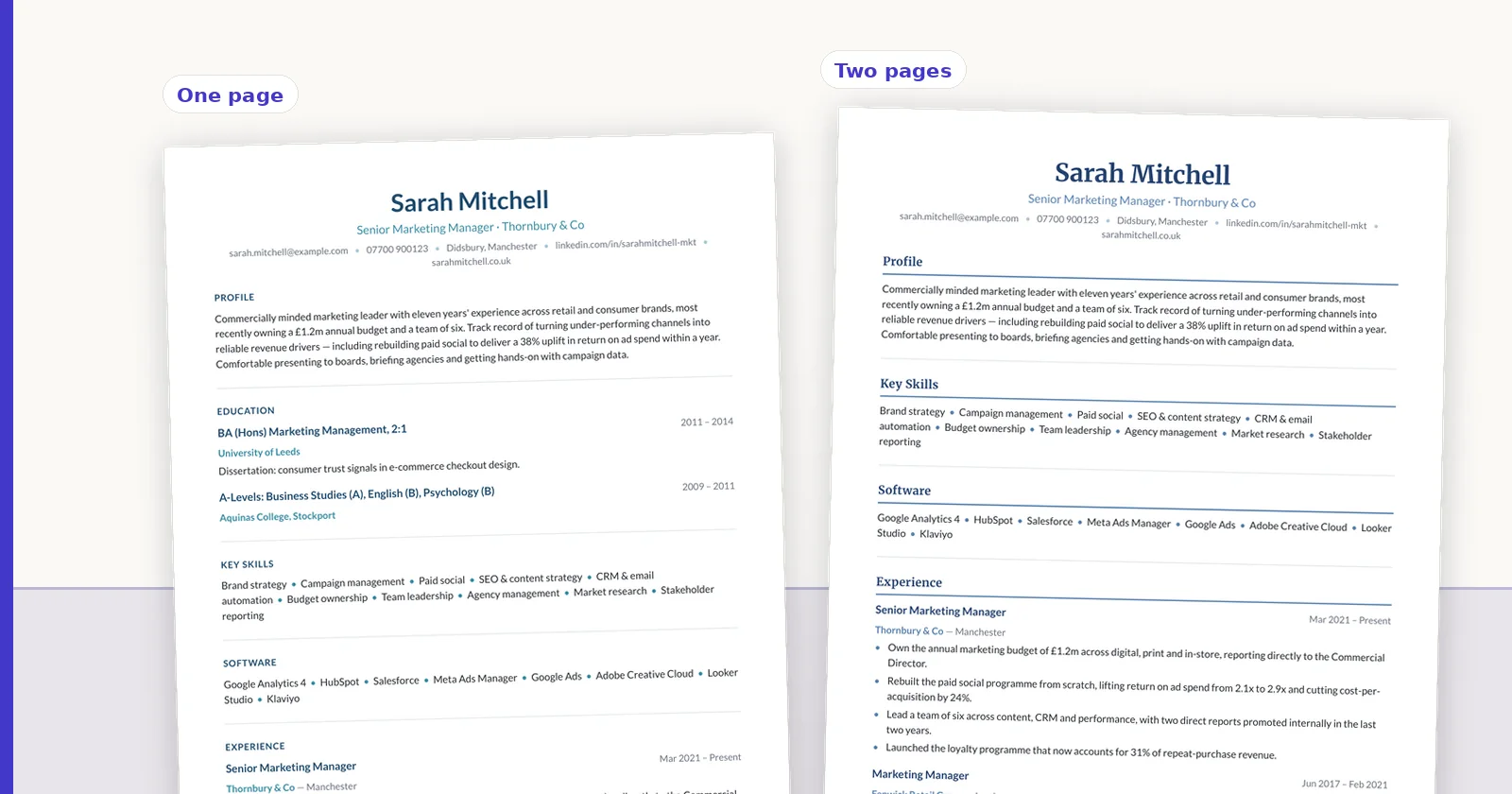
Step 6: Cut to length. One page for most people under about ten years of experience, two above that. Compress older roles rather than removing dates. How long should a resume be? covers what to cut first.
Step 7: Check the timeline once more. Read only the dates, top to bottom. They should run newest to oldest in every section with no unexplained jumps, and use one format throughout.
Reverse chronological resume example
Here is a short reverse chronological resume example for a fictional operations manager. The point is the shape: dates aligned on every role, the newest role with the most detail, and older roles shorter.
Jordan Reyes | Columbus, OH | (555) 010-4412 | [email protected]
Summary: Operations manager with nine years in distribution and fulfillment, leading teams of up to 40. Strong on process redesign and safety. Cut order cycle time 25% at a regional distributor.
Operations Manager, Midwest Supply Co., Columbus, OH | Mar 2022 to Present. Lead a 40-person warehouse team across two shifts. Redesigned pick paths and slotting, cutting order cycle time 25%. Ran the site's move to a new warehouse management system with no missed shipments.
Shift Supervisor, Lakeview Logistics, Dayton, OH | Jun 2018 to Feb 2022. Supervised 15 associates on the night shift. Introduced a cross-training rota that reduced overtime.
Warehouse Associate, Lakeview Logistics, Dayton, OH | Aug 2016 to May 2018.
Education: BS, Business Administration, Ohio State University, 2016.
Each section follows reverse chronological order, and the oldest role is a single line. That compression is what keeps a chronological resume to one or two pages.
More reverse chronological resume examples
The same format bends to fit very different careers. These three skeletons, all for fictional people, show where the emphasis moves.
Recent graduate, education first. Priya Nair | Austin, TX | [email protected]. Summary: Marketing graduate with two internships in B2B content and social media. Education: BBA, Marketing, University of Texas at Austin, May 2026. Experience: Marketing Intern, Hillcrest Software, Austin, TX | May 2025 to Aug 2025. Social Media Assistant (part-time), UT Recreational Sports | Sep 2023 to May 2026. Skills: HubSpot, Canva, Google Analytics, copywriting. Education leads because it is the strongest recent evidence; each section is still newest first.
Promotion within one company. Marcus Hill | Charlotte, NC. Experience: Northgate Bank, Charlotte, NC | Jun 2017 to Present. Vice President, Commercial Lending | Jan 2023 to Present (bullets). Assistant Vice President | Mar 2020 to Dec 2022 (bullets). Credit Analyst | Jun 2017 to Feb 2020 (one or two bullets). Listing the employer once with the titles stacked underneath shows progression clearly and stops a parser treating one employer as three separate jobs.
Long career, compressed. Diane Okafor | Denver, CO. Experience: Director of Finance, Front Range Health | 2019 to Present (five bullets). Controller, Summit Medical Group | 2014 to 2019 (four bullets). Senior Accountant, Alpine Partners | 2010 to 2014 (two bullets). Earlier experience: Staff Accountant roles at two regional CPA firms, 2004 to 2010. The last line keeps the timeline continuous without spending half a page on work from twenty years ago.
Why recruiters prefer the reverse chronological resume format
Most recruiters read a resume top to bottom in seconds, looking for current title, current employer, tenure and progression. The reverse chronological format puts all four in the first third of the page.
It also suits software. An applicant tracking system identifies jobs largely from a title sitting next to an employer and a date range. When every role follows the same title, employer, dates pattern in a single column, the parser has the easiest possible job. Gaps and overlaps are visible, which is a feature: a gap explained honestly reads better than one a layout tries to hide.
There is some evidence for the skim. The job site Ladders reported in November 2018 that recruiters in its eye-tracking study spent an average of 7.4 seconds on an initial resume screen, and that simple layouts with clear section and job headings held attention better than cluttered or multi-column ones. Whatever the exact figure, a format that puts title, employer and dates where the eye lands first is working with that habit rather than against it.
Chronological vs functional resume
A functional resume groups experience by skill area (for example, Project Management, Client Relations) and reduces the job history to a short list at the bottom, often without much detail. It is designed to lead with capability rather than titles.
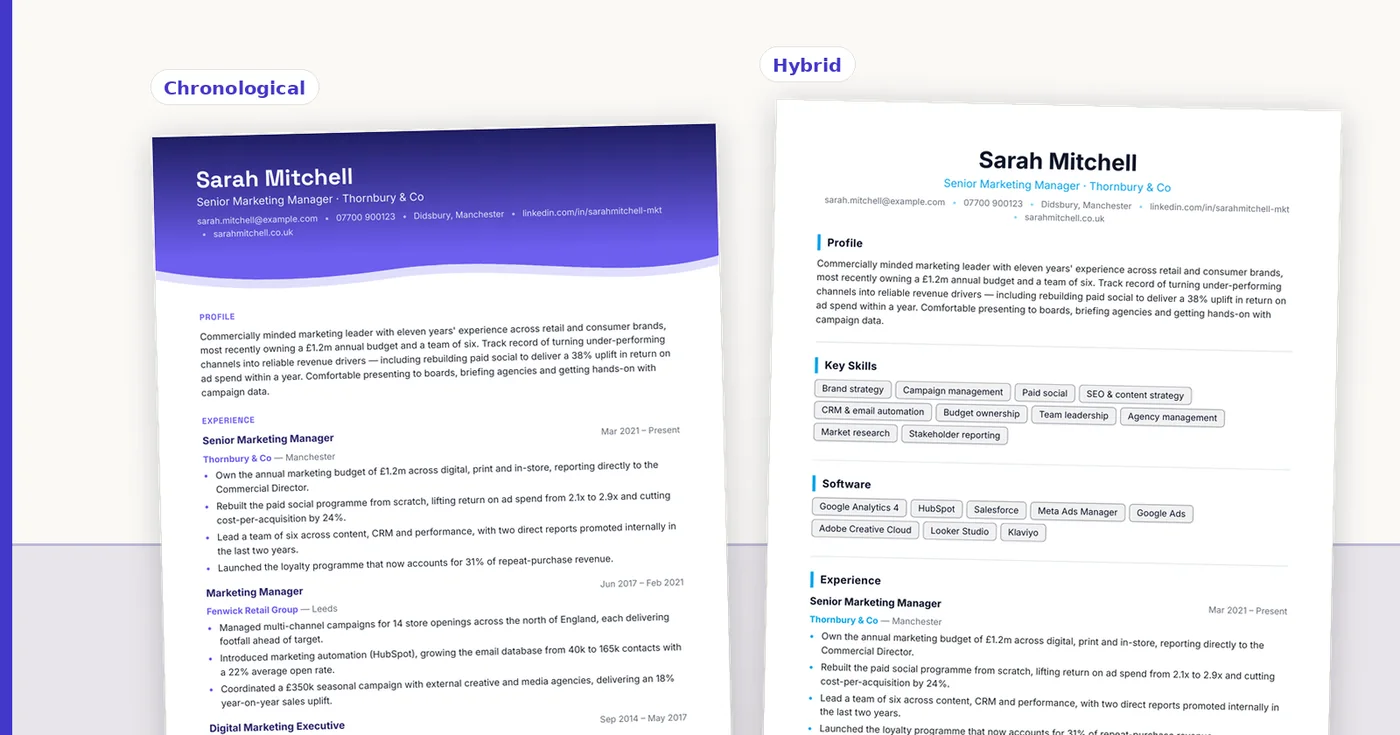
The difference between a chronological and functional resume matters most to recruiters. Many treat a functional resume with suspicion because it is often used to obscure a gap or a short tenure, and it is harder for an applicant tracking system to attach skills to jobs and dates. A hybrid (or combination) resume is the usual compromise: a short skills or summary section at the top, then a full reverse-chronological history.
- Use reverse chronological: a steady history in one field, recent experience that is relevant, or applying through online forms.
- Consider hybrid: a career change into an adjacent field, or a recent title that undersells what you did.
- Use functional rarely: only for a genuine career change where titles would mislead, and keep a dated job list on the page even then.
Chronological, functional and hybrid resumes compared
Most comparisons of resume formats stop at "chronological is best". That is true for most people, but the trade-offs are worth seeing side by side, especially if your history is unusual.
| Reverse chronological | Functional (skills-based) | Hybrid (combination) | |
|---|---|---|---|
| Leads with | Most recent job, then each earlier one | Skill groups, with a short job list at the end | A skills or summary block, then full dated history |
| Best for | Steady history in one field; most applicants | Rarely: a career change where titles would mislead | Career changers, returners, varied or contract histories |
| Shows progression | Clearly | Barely | Clearly, after the opening block |
| Shows gaps | Yes, plainly | Hides them, which readers notice | Yes |
| Applicant tracking systems | Parse it most reliably | Struggle to attach skills to jobs and dates | Parse it well if the history keeps title, employer and dates together |
| Recruiter reaction | Expected and easy to scan | Often treated with suspicion | Generally accepted |
Should your resume be in chronological order?
For most people, yes. Recent graduates sometimes put Education above Experience, which is fine as long as each section stays in reverse chronological order. Long careers can drop or compress roles older than 10 to 15 years rather than breaking the order.
The common mistakes are mixing orders (oldest job first in one section, newest first in another), inconsistent date formats, and leaving dates off older roles to hide age. Recruiters notice all three.
Formatting the dates and titles in a chronological resume
In a reverse chronological resume the dates are the spine of the page, so small inconsistencies show. A few conventions keep it clean:
- Use one date format everywhere: "Mar 2022 to Present" or "03/2022 to Present". Month and year is standard; year only is acceptable for roles older than ten years or for a whole career if used consistently.
- Put dates on the same line as the job title, aligned to the right margin, so the eye can run straight down them. In Word that is a right tab stop, not spaces or a table.
- Write "Present" for a current job, not a future end date and not "Current" in one place and "Now" in another.
- Keep the title, employer and dates together on one or two lines. Software matches jobs by that pattern, and a title separated from its dates can be attached to the wrong role.
- For education, the graduation year (or expected month and year) is enough. Leave out start years for degrees unless the posting asks.
Gaps, short roles and long careers in a chronological resume
Because every role carries dates, a chronological resume shows gaps plainly. That is usually better than trying to hide them. A one-line entry such as "Career break: family care, Jan 2023 to Aug 2024" or "Full-time study" answers the question before the reader asks it, and keeps the timeline continuous for an applicant tracking system.
Short roles of a few months can be grouped under one heading when they were contract or temporary work, for example "Contract assignments, 2021 to 2022" with the clients listed underneath. Staffing agency placements work the same way: name the agency as the employer and the client sites in the bullets.
For a long career, keep the last 10 to 15 years in full and compress anything older into an "Earlier experience" line with titles and employers but fewer or no bullets. That keeps the reverse chronological resume format intact while holding the page count to one or two pages. Removing old dates entirely tends to read as hiding age, so keep years on every entry you include.
If a role you held earlier is more relevant than your current one, resist moving it to the top. Instead, give it more bullets than its position would normally earn, and mention it in the summary so the reader knows to look for it.
A reverse chronological resume template, without retyping
Most of our resume templates use a reverse-chronological layout, including the classic, minimal, timeline and executive families. You upload the resume you already have, as a PDF or Word file, and get it back in the template with dates aligned on every role, exported as a PDF and an editable Word file. The PDF is exact; the Word file is a close approximation you can keep editing.
Your first conversion is free with no card. If you would rather build the layout by hand, how to format a resume in Word covers the settings that keep a chronological resume stable.
FAQ
Q01How do I write a reverse chronological resume?
Start with a header and a three- or four-line summary, then list each job with the most recent first: title, employer, location and dates, followed by achievement bullets. Put education and certifications in the same order, newest first, and keep older roles shorter.
Q02What is an example of reverse chronological order?
If you worked at Company A from 2016 to 2018, Company B from 2018 to 2022 and Company C from 2022 to now, a reverse chronological resume lists Company C first, then B, then A.
Q03Do employers prefer chronological or functional resumes?
Most prefer chronological. It shows progression and recent experience at a glance, and it parses cleanly in applicant tracking systems. Functional resumes are often read as an attempt to hide gaps.
Q04Should a resume be in chronological order by start or end date?
By end date, most recent first, so your current or latest role is at the top. For overlapping roles, the one that is ongoing or ended later goes first.
Q05What are the sections of a resume?
Header, summary, experience, education and skills are standard, in roughly that order. Certifications, projects, volunteer work and languages are added when they support the job you want.
Q06Is there a word for reverse chronological order?
On a resume it is usually just called chronological order, since nobody lists their oldest job first. "Reverse chronological" is the more precise term and the one career services and recruiters use.
Q07Does your resume have to be in chronological order?
No rule requires it, but most employers expect it, and applicant tracking systems read it most reliably. Should a resume be in chronological order if your best experience is older? Usually still yes: keep the order and give the older role more bullets, or use a hybrid format with a short skills section on top.
Q08How far back should a chronological resume go?
Usually 10 to 15 years in full detail. Older roles can be compressed into an "Earlier experience" line with titles and employers, or left off if they add nothing for the job. Keep dates on everything you include.
Q09How do I show a promotion on a reverse chronological resume?
List the employer once with its full date range, then stack each title underneath with its own dates, newest first. Give the current title the most bullets. This shows progression and stops the company looking like several separate jobs.
Q10Is a chronological resume good for a first job?
Yes. Put education first, then any internships, part-time work, volunteering or campus roles in reverse chronological order. Even short or unpaid experience reads better with dates than without.
ConnectIQ Editorial documents practical recruitment operations and the controls implemented in the ConnectIQ product. This guide is general operational information, not legal advice.